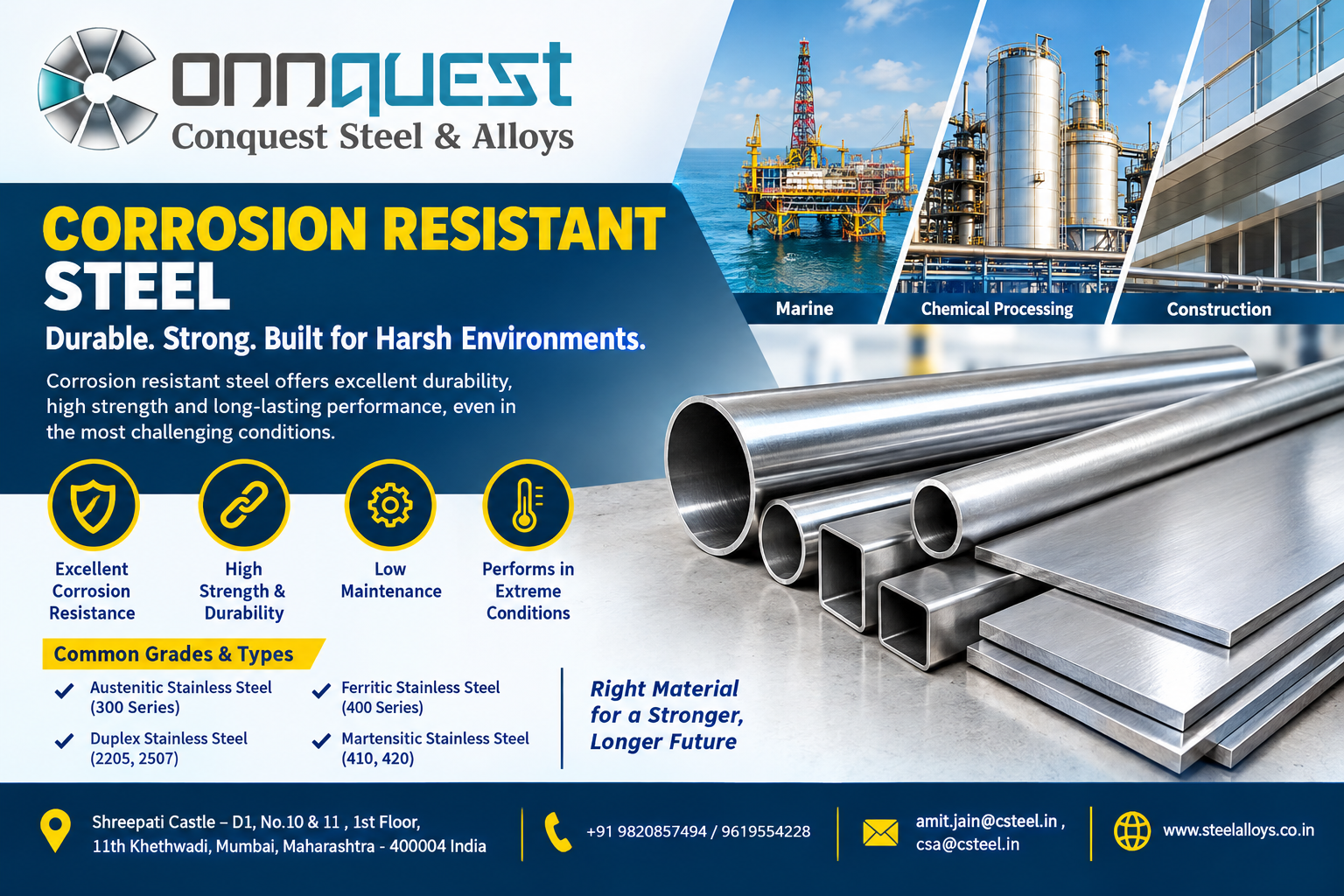
Corrosion Resistant Steel
- Conquest Steel & Alloys Team
Corrosion Resistant Steel: Grades, Types, Properties & Applications | Guide by Conquest Steel & Alloys - Top Corrosion Resistant Steel Manufacturers & Suppliers Since 2008
Corrosion resistant steel is steel that resists rust through its chemistry or its coating. The main families are stainless steel, weathering steel (Corten) and galvanized steel. Each protects the metal in a different way, so each suits a different environment.
Conquest Steel & Alloys is a Mumbai-based stockist, incorporated in 2008, that supplies Corten steel plates, coil, flat, pipe and tube across India. Our promoters and partners bring 30 years of experience in steel sourcing, stocking and supply chain.
Corten is a weather resistant steel alloyed with copper, chromium and nickel. After repeated wet and dry cycles, it forms a dense patina that slows further corrosion. That is why architects and engineers use it for facade cladding, bridges, towers and landscape structures without paint.
We stock ASTM A242 (Corten A) and ASTM A588 (Corten B) plates. We also supply IS 11587 and EN 10025-5 S355J2W grades. Our stockyards at Kalamboli and Taloja cut plates to size by oxyfuel and plasma methods. Our in-house quality team performs ultrasonic testing, and we arrange quality documentation, including mill test certificate support.
Corten resists atmospheric corrosion, not abrasion. For wear service, you need abrasion resistant (AR) plate. For continuous immersion or heavy chloride exposure, you may need stainless or duplex steel instead.
This guide explains grades, types, composition, specifications, equivalents, indicative pricing and selection criteria. It also shows how to request a written quote. We do not publish fixed rates, because steel prices move with the market. Send us your grade, thickness, quantity and delivery location, and our team replies with a written quotation.
What Is Corrosion Resistant Steel?
Corrosion resistant steel is steel that resists rust and chemical attack through alloying elements or protective coatings. Chromium, nickel, molybdenum and copper are the main alloying elements. Zinc is the most common coating.
Engineers choose it when plain carbon steel would rust too quickly, need repeated painting, or fail early. Three families dominate industrial use:
- Stainless steel relies on chromium for a self-healing surface film.
- Weathering steel (Corten) builds a stable rust patina in open air.
- Galvanized steel carries a sacrificial zinc coating.
Definition of Corten steel: Corten steel is a weather resistant, high-strength low-alloy steel containing copper, chromium and nickel. Alternating wet and dry cycles form a dense, adherent rust layer that slows further corrosion, so the steel needs no paint. Conquest Steel & Alloys specialises in this last category: weathering steel plates and products, supplied from Mumbai since 2008.
How Does Corrosion Resistant Steel Work?
Each type of corrosion resistant steel protects itself differently. Stainless steel forms an invisible oxide film. Weathering steel grows a visible patina. Galvanized steel sacrifices a zinc layer to protect the steel beneath.
1. Passive chromium oxide layer (stainless steel). Stainless steel contains at least 10.5% chromium. Chromium reacts with oxygen to form a thin, invisible oxide film. If scratches damage the film, it reforms in the presence of oxygen.
2. Stable patina formation (weathering steel). Corten’s copper-chromium-nickel alloying helps it form a tight rust layer through repeated wet and dry cycles. The process runs in three stages:
- Initial rusting: Fresh plate shows bright orange rust within weeks of outdoor exposure.
- Patina formation: Over months to a few years, the rust darkens and stabilises.
- Protection: The dense layer blocks oxygen and moisture, so the corrosion rate drops sharply.
3. Sacrificial zinc coating (galvanized steel). Zinc corrodes in preference to the steel underneath. The coating acts as a barrier and as sacrificial protection, even at minor scratches.
Where Corten works best: Open-air exposure with regular drying, such as facades, bridges and landscape work.
Where to take care: Continuous immersion, burial in wet soil, trapped moisture and heavy salt or chloride exposure can stop the patina from forming. Design drainage into your detail, and plan for rust run-off, which can stain concrete and paving.
Types of Corrosion Resistant Steel
The five main types are austenitic stainless, duplex stainless, ferritic and martensitic stainless, weathering steel and galvanized steel. The right choice depends on the environment, the loads and the budget.
Austenitic Stainless Steel (304, 316, 316L)
Austenitic grades typically contain 16–20% chromium and 8–14% nickel. Grade 316 adds 2–3% molybdenum, which improves resistance to chlorides, salt and marine environments. Grade 316L has lower carbon, which helps in welded structures. Grade 304 handles most atmospheric and mild chemical conditions.
Duplex and Super Duplex Stainless Steel
Duplex steel combines austenitic and ferritic structures. It delivers high strength and strong resistance to pitting and stress corrosion cracking in chloride-heavy or chemical settings. It costs more than 304 or 316, but thinner sections often offset the premium.
Ferritic and Martensitic Stainless Steel (430, 410)
These grades offer cost-effective protection in moderate corrosion environments. Ferritic grade 430 suits trim and appliances. Martensitic grade 410 suits parts that need higher hardness.
Weathering Steel (Corten Steel)
Corten forms a stable, rust-like protective layer after atmospheric exposure, which prevents deeper decay without paint. The main grades are Corten A (ASTM A242) and Corten B (ASTM A588). Indian projects often specify IS 11587, and European projects often specify EN 10025-5 S355J2W.
Buyers in India also search for Corten weathering steel, Corten corrosion resistant steel and Corten weather resistant steel. These names describe the same family of weathering steel products.
Galvanized Steel
Galvanized steel is carbon steel coated with zinc. The zinc acts as a sacrificial barrier against moisture and oxygen. It suits fencing, roofing, ducting and general fabrication.
Our focus: Conquest Steel & Alloys supplies Corten (weathering) steel. For stainless, duplex or galvanized requirements,
Composition and Properties of Corrosion Resistant Steel
Composition decides how a steel resists corrosion. Stainless grades depend on chromium, nickel and molybdenum. Corten depends on small additions of copper, chromium and nickel.
|
Grade |
Composition, Strength & Corrosion Resistance |
|---|---|
|
304 Stainless Steel |
Chromium: 18–20%; Nickel: 8–10.5%; Molybdenum: None; Min. Tensile Strength: 515 MPa; Corrosion Resistance: Good in atmospheric conditions and mild chemicals |
|
316 Stainless Steel |
Chromium: 16–18%; Nickel: 10–14%; Molybdenum: 2–3%; Min. Tensile Strength: 515 MPa; Corrosion Resistance: Superior in chloride-rich and marine environments |
|
2205 Duplex Stainless Steel |
Chromium: 22–23%; Nickel: 4.5–6.5%; Molybdenum: 3–3.5%; Min. Tensile Strength: 655 MPa; Corrosion Resistance: Excellent resistance to pitting and stress corrosion cracking |
|
430 Ferritic Stainless Steel |
Chromium: 16–18%; Nickel: None; Molybdenum: None; Min. Tensile Strength: 450 MPa; Corrosion Resistance: Moderate |
|
410 Martensitic Stainless Steel |
Chromium: 11.5–13.5%; Nickel: None; Molybdenum: None; Min. Tensile Strength: 450 MPa; Corrosion Resistance: Moderate; hardenable by heat treatment |
|
Corten B (ASTM A588 Gr A) |
Chromium: 0.40–0.65%; Nickel: Up to 0.40%; Molybdenum: None; Min. Tensile Strength: 485 MPa; Corrosion Resistance: Atmospheric corrosion resistance through protective patina formation |
Values are typical and vary by product form and standard.
Corten Steel Plate Chemical Composition
Corten’s chemical composition is what drives patina formation. Typical ASTM A588 Grade A limits include:
| Element | Typical Limit (%) |
|---|---|
| Carbon (C) | 0.19 max |
| Manganese (Mn) | 0.80–1.25 |
| Silicon (Si) | 0.30–0.65 |
| Chromium (Cr) | 0.40–0.65 |
| Copper (Cu) | 0.25–0.40 |
| Nickel (Ni) | 0.40 max |
| Vanadium (V) | 0.02–0.10 |
| Phosphorus (P) | 0.04 max |
| Sulphur (S) | 0.05 max |
Key properties of Corten plate:
- High strength: It is a high-strength low-alloy structural steel, so designers can use thinner sections.
- Self-protection: The patina removes the need for paint in suitable environments.
- Weldability: Welding is practical with the right procedure and consumables.
- Aesthetic change: The surface shifts from bright orange-brown to a deep burgundy-brown over time.
Corrosion Resistant Steel Specifications and Standards
The main Corten plate standards are ASTM A242 (Corten A), ASTM A588 (Corten B), IS 11587 and EN 10025-5 (such as S355J2W). Buyers should match the grade on the mill test certificate to the project specification.
Grades and Standards
| Grade / Standard | Reference | Typical Use |
|---|---|---|
| Corten A | ASTM A242 / ASME SA242 | Facade cladding, architectural panels, planters, lighter structural parts |
| Corten B | ASTM A588 / ASME SA588 | Bridges, structural frames, heavier fabrication |
| IS 11587 | Indian standard for structural weather resistant steel | Structural fabrication, towers, rolling stock in India |
| EN 10025-5 S355J2W | European standard for weather resistant structural steel | Outdoor structures needing impact toughness, such as bridges |
| Other EN 10025-5 grades (S235J0W, S355J0W, S355K2W) | European standard | Project-specific structural needs |
Sample Corten Steel Plate Specification Table
| Parameter | Typical Range |
|---|---|
| Specifications | ASTM A242 / ASME SA242, A588 / ASME SA588 |
| Type | Corten steel / high-strength low-alloy structural steel |
| Process | Hot-rolled (HR) |
| Thickness | 0.8 mm to 50 mm |
| Width | 750 mm to 1500 mm |
| Length | 2500 mm to 12000 mm |
| Yield strength, A588 Gr A | 345 MPa min (thickness dependent) |
| Tensile strength, A588 Gr A | 485 MPa min |
| Yield strength, S355J2W | 355 MPa min up to 16 mm |
| Tensile strength, S355J2W | 470–630 MPa |
| IS 11587 strength values | |
| Supply condition | Hot-rolled |
Corten Steel Plate Size Chart
| Thickness | Width | Length |
|---|---|---|
| 1/4 inch | 60 inch | 120 inch |
| 1/4 inch | 48 inch | 120 inch |
| 3/8 inch | 48 inch | 120 inch |
| 1/2 inch | 48 inch | 120 inch |
Corten plate thickness is available from 3/16 inch up to 2 inch, and thicker sections from over 2 inch to 5 inch on request.
Corten Plate Weight
Weight per unit area helps with transport, lifting and cost planning. Steel weighs about 40.8 lb per square foot for each inch of thickness.
| Thickness | Weight (lb/ft²) | Weight (kg/m², approx.) |
|---|---|---|
| 1/4 inch | 10.21 | 49.9 |
| 3/8 inch | 15.32 | 74.8 |
| 1/2 inch | 20.42 | 99.7 |
Corten Steel Plate Stock Availability
Typical stocked gauges and widths are shown below. Stock changes daily, so confirm availability with our team.
| Gauge | 96" x 240" | 72" Wide | 60" Wide | 48" Wide |
|---|---|---|---|---|
| 3/16" | Yes | Yes | Yes | Yes |
| 1/4" | Yes | Yes | Yes | Yes |
| 5/16" | Yes | – | – | – |
| 3/8" | Yes | Yes | Yes | Yes |
| 1/2" | Yes | Yes | Yes | Yes |
| 5/8" | Yes | – | – | – |
| 3/4" | Yes | Yes | Yes | Yes |
| 1" to 2" | Yes | – | – | – |
Benefits of Corrosion Resistant Steel
The main benefits are a long service life, low maintenance, high strength and lower lifecycle cost. Buyers who compare total cost of ownership, not just price per tonne, often favour corrosion resistant steel.
- Long service life: The protective layer or alloy chemistry slows deterioration for decades in suitable environments.
- Low maintenance: Corten needs no paint, so you skip repainting cycles and access costs.
- High strength: High-strength low-alloy grades let designers specify thinner, lighter sections.
- Lifecycle cost savings: A higher purchase price often pays back through reduced maintenance.
- Recyclability: Steel is fully recyclable, which supports sustainability goals.
- Distinctive appearance: Corten’s evolving burgundy-brown surface gives architects a warm, rustic finish.
Applications of Corrosion Resistant Steel
Buyers use corrosion resistant steel where long outdoor life and low maintenance matter more than a painted finish. Common sectors include construction, infrastructure, transport, energy and process industries.
Corten and weathering steel applications:
- Facade cladding and architectural screens
- Bridges and pedestrian walkways
- Railway wagons and transport structures
- Transmission towers, poles and signage structures
- Storage structures, silos and chimneys
- Landscape features, planters, retaining edges and sculpture
Stainless and duplex steel applications:
- Marine and offshore equipment
- Oil and gas processing
- Chemical processing plants
- Water treatment
- Food processing and power plants
Match the material to the exposure. Corten performs well in open air with wet and dry cycles. Stainless and duplex grades suit chemical, immersed or chloride-heavy service.
Corrosion Resistant Steel vs Regular Steel
Corrosion resistant steel lasts longer outdoors and needs less maintenance than regular steel, but it costs more per tonne. Regular carbon steel rusts in flakes that keep eating into the metal. Corrosion resistant steel resists or slows that attack.
| Factor | Corrosion Resistant Steel | Regular Carbon Steel |
|---|---|---|
| Composition | Alloyed (Cr, Ni, Cu, Mo) or coated | Iron and carbon, minimal alloying |
| Rust behaviour | Stable patina, passive film or sacrificial coating | Loose, flaking rust that keeps corroding |
| Lifespan outdoors | Long, with proper design | Short without paint |
| Maintenance | Low | High (repeated painting) |
| Upfront cost | Higher | Lower |
| Typical uses | Facades, bridges, marine, chemical plants | Indoor frames, general fabrication |
Is Corten the Same as Wear Resistant Steel?
No. Corten is a weather resistant steel, not an abrasion resistant (AR) steel. Corten fights atmospheric corrosion. It does not offer the surface hardness needed to resist sliding wear or impact abrasion.
| Feature | Corten (weathering steel) | Wear resistant steel (AR plate) |
|---|---|---|
| Main purpose | Resists atmospheric corrosion | Resists abrasion and wear |
| Protection method | Self-forming rust patina | High surface hardness |
| Typical use | Facades, bridges, outdoor structures | Chutes, hoppers, buckets, liners |
If your application involves abrasion, tell us at the enquiry stage. We will help you choose the right plate.
Corten Steel Equivalent Material
Corten A corresponds to ASTM A242 and Corten B to ASTM A588, with close equivalents in EN, JIS, BS and IS standards. Equivalent grades behave similarly but are not identical.
|
EN 10025-5 / EN 10155 Grade |
Equivalent Standards & Material Details |
|---|---|
|
S355J0W |
Material No.: 1.8959; ASTM Equivalent: A588 / A242; JIS Equivalent: SMA 50 AW; BS 4360 / Other: WR 50 B |
|
S355J2G1W |
Material No.: 1.8963; ASTM Equivalent: A588 Gr A; JIS Equivalent: Not specified; BS 4360 / Other: WR 50 C, WTSt 52-3 |
|
S355J0WP |
Material No.: 1.8945; ASTM Equivalent: A242; JIS Equivalent: Not specified; BS 4360 / Other: WR 50 A, Fe 510 C1K1 |
|
S355J2WP |
Material No.: 1.8946; ASTM Equivalent: A242; JIS Equivalent: Not specified; BS 4360 / Other: Fe 510 D1K1 |
|
S355K2G1W |
Material No.: 1.8966; ASTM Equivalent: A709 Gr 50 W; JIS Equivalent: Not specified; BS 4360 / Other: Not specified |
|
S235J2W |
Material No.: 1.8961; ASTM Equivalent: Not specified; JIS Equivalent: Not specified; BS 4360 / Other: WTSt 37-3, Fe 360 DK1 |
Cross-references are indicative. Compare the chemistry and mechanical properties on the mill test certificate with your project specification.
Corten Steel Plate Price
Indicative Corten steel plate prices in India range from about ₹80,000 to ₹1,35,000 per tonne (₹80 to ₹135 per kg). Pipe and tube cost more because of extra processing. These are indicative figures that depend on grade, thickness, quantity and market rates. They are not fixed quotes.
| Product Form | Grade | Indicative Price (₹ per tonne) | Indicative Price (₹ per kg) |
|---|---|---|---|
| Corten steel plate | Corten A (ASTM A242) | ₹95,000 to ₹1,30,000 | ₹95 to ₹130 |
| Corten steel plate | Corten B (ASTM A588) | ₹95,000 to ₹1,35,000 | ₹95 to ₹135 |
| Corten steel plate | S355J2W (EN 10025-5) | ₹90,000 to ₹1,25,000 | ₹90 to ₹125 |
| Corten steel plate | IS 11587 | ₹80,000 to ₹1,10,000 | ₹80 to ₹110 |
| Corten steel coil | Grade as required | ₹85,000 to ₹1,20,000 | ₹85 to ₹120 |
| Corten flat | Grade as required | ₹90,000 to ₹1,30,000 | ₹90 to ₹130 |
| Corten pipe | Grade as required | ₹1,10,000 to ₹1,70,000 | ₹110 to ₹170 |
| Corten tube | Grade as required | ₹1,20,000 to ₹1,85,000 | ₹120 to ₹185 |
Prices are indicative, exclude GST, freight and cutting charges, and change with market rates.
What affects your price:
- Grade and standard: ASTM A588 and EN grades often cost more than basic structural grades.
- Thickness and size: Unusual sizes cost more.
- Quantity: Larger orders improve your rate.
- Processing: Cutting to size adds cost but reduces your waste.
- Market conditions: Steel rates move often.
Looking for a current Corten steel HR plates price list? Send your requirement, and we reply with a written quote.
Other Corrosion Resistant Metals That Don’t Rust
Titanium, aluminium, copper alloys and nickel alloys also resist corrosion, though each works differently from steel. Most cost far more than steel, so engineers reserve them for demanding service.
- Titanium: It forms a tough oxide film and performs exceptionally in seawater and chlorine environments.
- Aluminium: It forms a thin oxide layer and offers a light weight, but it has lower strength than steel.
- Copper alloys (brass, bronze): These resist seawater and biofouling, so marine fittings often use them.
- Nickel alloys (Inconel, Monel): These withstand extreme heat and aggressive chemicals.
None of these is a drop-in replacement for structural steel plate. For most outdoor structural projects, Corten or stainless steel offers the best balance of cost and performance.
How to Select the Right Corrosion Resistant Steel for Your Project
Start with the environment, then match the grade, mechanical needs, budget and documentation. A wrong match leads to early failure or unnecessary cost.
- Define the environment. Open air with wet and dry cycles favours Corten. Immersion, burial or heavy chlorides point to stainless or duplex steel.
- Choose the grade and standard. Corten A (ASTM A242) suits cladding and lighter work. Corten B (ASTM A588) suits heavier structural duty. Use IS 11587 or EN 10025-5 S355J2W when the project specification requires them.
- Check mechanical requirements. Confirm yield strength, tensile strength and impact toughness for your design loads and temperatures.
- Plan the details. Add drainage, avoid trapped moisture and plan for rust run-off onto adjacent concrete or paving.
- Set your budget on lifecycle cost. Compare maintenance savings, not just price per tonne.
- Demand certification. Ask for a mill test certificate and compare it to your specification before you order.
- Confirm processing needs. Decide whether you need cutting to size, ultrasonic testing and special packing.
Not sure which grade fits? Share your application with our team before you order.
Why Choose Conquest Steel & Alloys?
Conquest Steel & Alloys is a Mumbai-based steel stockist, incorporated in 2008, that supplies Corten steel and other steel plates to industrial buyers. Our promoters and partners bring 30 years of experience in steel sourcing, stocking and supply chain. We source plates from manufacturers and mills that follow international guidelines for plate production.
Our Growth Timeline
- 2008: We opened our Khetwadi head office in Mumbai (750 sq.ft.). The same year, we set up a 900 sq.m stockyard at Kalamboli with two OET cranes and an oxyfuel cutting facility.
- 2011: We built a 3,000 sq.m stockyard at Taloja with three OET cranes, each of 20-ton capacity. It offers plasma and oxyfuel cutting, and a team of eight handles stock management, dispatch, cutting and planning.
- 2015: We opened a 10,000 sq.m warehouse at Taloja, half closed and half open. It raised our stock capacity ten times compared with 2008. A team of 14 manages stock, packing, dispatch and cutting plans.
- 2024: We operate our Khetwadi head office from a 1,500 sq.ft. location with 15 team members across administration, marketing, purchase and sales.
Which Corten Steel Products Do We Supply?
- Corten steel plate: The most common form for facade cladding, structural fabrication, tanks and heavy sections.
- Corten steel coil: Suits roll-formed panels, sheets and profiles where long continuous lengths help.
- Corten pipe and tube: Suit structural hollow sections, railings, columns, sculpture and landscape features.
- Corten flat: Suits frames, supports, brackets, edging and fabricated components.
We also supply hot-rolled Corten steel sheets and plates.
How Do We Test, Cut and Document Corten Steel?
We cut Corten steel to size, test it by ultrasonic methods and arrange quality documentation. These services come from our own stockyards and our in-house quality team.
- Cutting to size: Oxyfuel cutting at Kalamboli. Plasma and oxyfuel cutting at Taloja. Our teams prepare cutting plans to reduce waste.
- Ultrasonic testing: Our in-house quality team performs ultrasonic testing. We do not carry out destructive testing in-house.
- Quality documentation: We arrange quality records, including mill test certificate support.
- Packing and dispatch: Our stockyard teams pack and dispatch material, using OET cranes for safe loading.
Other Types of Corten Plate We Supply Globally
Our range covers Corten A, Corten B, S355J2W and IS 11587 plate, plus coil, flat, pipe and tube. We serve buyers across India from Mumbai.
We Supply Our Corten Plate to various countries like Vietnam, Bulgaria, United States, United Kingdom, Argentina, Belgium, Lithuania, Saudi Arabia, Gabon, Portugal, Estonia, Puerto Rico, Iran, Sweden, Bolivia, Pakistan, South Korea, Nepal, Hong Kong, Netherlands, Tunisia, Norway, Trinidad & Tobago, Canada, Mongolia, Finland, Slovakia, France, Angola, Serbia, Belarus, Iran, Ukraine, Qatar, Denmark, Peru, Czech Republic, Iraq, Chile, Malaysia, Russia, Oman, Morocco, Libya, Chile, New Zealand, Nigeria, Croatia, Nigeria, Italy, Brazil, Ecuador, Ireland, Bhutan, China, Tibet, Turkey, Jordan, Lebanon, Philippines, Israel, Romania, Sri Lanka, Germany, Ghana, Bahrain, South Africa, Greece, Mexico, Colombia, Bangladesh, Gambia, United Arab Emirates, Algeria, Kazakhstan, Switzerland, Austria, Hungary, Venezuela, Mexico, India, Poland, Macau, Namibia, Singapore, Zimbabwe, Yemen, Japan, Azerbaijan, Kenya, Taiwan, Egypt, Australia, Indonesia, Thailand, Poland, Spain, Afghanistan, Costa Rica, Kuwait. Nashik, Bangkok, Perth, Vadodara, Sharjah, Dallas, Houston, New York, London, Kolkata, Geoje-si, Busan, Manama, Chennai, Jakarta, Brisbane, Dammam, Santiago, Mexico City, Mumbai, Kanpur, Visakhapatnam, Doha, Ulsan, Secunderabad, Aberdeen, Gurgaon, Istanbul, Singapore, Atyrau, Abu Dhabi, Chiyoda, Rajkot, Al Jubail, Muscat, Faridabad, Madrid, Ahmedabad, Pimpri-Chinchwad, Tehran, Dubai, Montreal, Bengaluru, Vung Tau, Indore, Pune, Courbevoie, Thane, Los Angeles, Ludhiana, Jamshedpur, Rio de Janeiro, Edmonton, Navi Mumbai, Calgary, Gimhae-si, Noida, Baroda, Granada, Kuala Lumpur, Chandigarh, Kuwait City, Lahore, Haryana, Melbourne, Ranchi, Riyadh, Hong Kong, Ahvaz, Cairo, Jeddah, Ernakulam, Thiruvananthapuram, Algiers, Moscow, Nagpur, Al Khobar, Ankara, Howrah, Port-of-Spain, Bhopal, Hyderabad, Petaling Jaya, New Delhi, Surat, Bogota, Karachi, Seoul, Milan, Jaipur, Sydney, La Victoria, Toronto, Caracas, Lagos, Hanoi, Ho Chi Minh City, Colombo, Coimbatore.
Frequently Asked Questions About Corrosion Resistant Steel
What type of steel is corrosion resistant?
Stainless steel (austenitic, duplex and ferritic), weathering steel such as Corten, and galvanized steel are the main corrosion resistant types. Stainless steel relies on chromium, weathering steel forms a rust patina, and galvanized steel uses a zinc coating. Choose by environment, load and budget.
Is 304 or 316 more corrosion resistant?
Grade 316 is more corrosion resistant than 304. Its 2–3% molybdenum content improves resistance to chlorides, salt spray and marine environments. Grade 304 performs well in most atmospheric and mild chemical conditions, but it can pit in chloride-rich settings. Choose 316 for coastal, marine or chemical exposure.
Is 304 steel corrosion resistant?
Yes. Grade 304 resists most atmospheric, food-processing and mild chemical environments because its 18–20% chromium forms a passive oxide film. It can pit or suffer crevice corrosion in chloride-rich conditions such as seawater or de-icing salts. Grade 316 suits those harsher settings better.
What is the difference between corrosion resistant steel and TMT steel?
Corrosion resistant steel is alloyed or coated to resist rust. TMT bars are reinforcement rebar for concrete, and standard TMT is not corrosion resistant. Some manufacturers sell corrosion resistant TMT (often called CRS TMT) alloyed with elements such as chromium or copper. Plates such as Corten serve a different purpose from rebar.
Which metal is most corrosion resistant?
Titanium, tantalum and certain nickel alloys such as Hastelloy and Inconel rank among the most corrosion resistant metals. Among steels, super duplex and high-molybdenum stainless grades perform best. The best choice depends on the chemical, temperature and chloride level of the environment, and on cost.
What are the 7 types of corrosion?
Seven common types are uniform, galvanic, pitting, crevice, intergranular, stress corrosion cracking and erosion corrosion. Each attacks metal differently. Pitting and crevice corrosion cause localised damage, while uniform corrosion spreads evenly. Knowing the type helps engineers pick the right grade, coating or design detail.
What is the difference between Corten steel and regular mild steel?
Corten contains copper, chromium and nickel, which help it form a dense, adherent patina during wet and dry cycles. Mild steel forms loose, flaking rust that keeps corroding, so it needs paint or coating. Corten costs more per tonne but cuts repainting and maintenance over a structure’s life.
Does Corten steel rust completely over time?
No. Corten rusts on the surface, but the patina seals the metal and slows further corrosion, so the plate does not rust through under normal open-air exposure. Constant wetness, soil burial, trapped moisture and heavy salt exposure can stop the patina from stabilising and cause continued corrosion.
What are the equivalents of Corten steel under ASTM standards?
Corten A matches ASTM A242 and Corten B matches ASTM A588. Related grades include EN 10025-5 S355J0W and S355J2W, JIS G3114 SMA 50 AW and IS 11587. Equivalent grades behave similarly but are not identical, so compare the mill test certificate against your specification.
Is Corten steel suitable for high-temperature or marine environments?
Corten suits open-air outdoor use, including inland and mild coastal sites with wet and dry cycles. It performs poorly under continuous immersion, burial in wet soil and heavy salt or chloride exposure. It is not designed for elevated-temperature pressure service. Consider stainless or duplex steel for those conditions.
What is the average price per kg of Corten steel plates?
Indicative Corten steel plate prices in India range from about ₹80 to ₹135 per kg, depending on grade, thickness, quantity and market rates. Pipe and tube cost more. These figures exclude GST, freight and cutting, and are not fixed quotes. Send your requirement for a written quotation.
Contact Conquest Steel & Alloys for Corrosion Resistant Steel for Best Price in India
Corrosion resistant steel gives designers and fabricators a durable, low-maintenance material for demanding outdoor work. Corten’s copper-chromium-nickel chemistry builds a protective patina, which cuts repainting and lowers the total cost of ownership over the life of a facade, bridge or structure.
Choosing the right grade matters. Corten A under ASTM A242 suits cladding and lighter fabrication. Corten B under ASTM A588 suits heavier structural duty. IS 11587 and EN 10025-5 S355J2W serve projects written to Indian or European standards. Always check the mill test certificate against your specification, and remember that Corten resists atmospheric corrosion, not abrasion.
Conquest Steel & Alloys has supplied steel from Mumbai since 2008, backed by 30 years of promoter and partner experience. Our Kalamboli and Taloja stockyards hold material, cut it to size with oxyfuel and plasma equipment, and prepare it for dispatch. Our in-house team performs ultrasonic testing and arranges quality documentation.
We keep the process transparent:
- Share your requirement: Grade, standard, thickness, width, length, quantity and delivery location.
- Receive your quote: We reply with a written quotation based on current market rates.
- Confirm and dispatch: After you approve, we cut, pack and dispatch from our Kalamboli or Taloja stockyard.
Ready to buy Corten steel at the best price in India? Request a quote through our enquiry form or call +91 9820857494 or 9619554228 to discuss your project with our team today.
Conquest Steel & Alloys
Head office: Shreepati Castle – D1, No. 10 & 11, 1st Floor, 11th Khetwadi, Mumbai, Maharashtra – 400004, India
Phone: +91 9820857494, 9619554228
Email: amit.jain@csteel.in, csa@csteel.in


