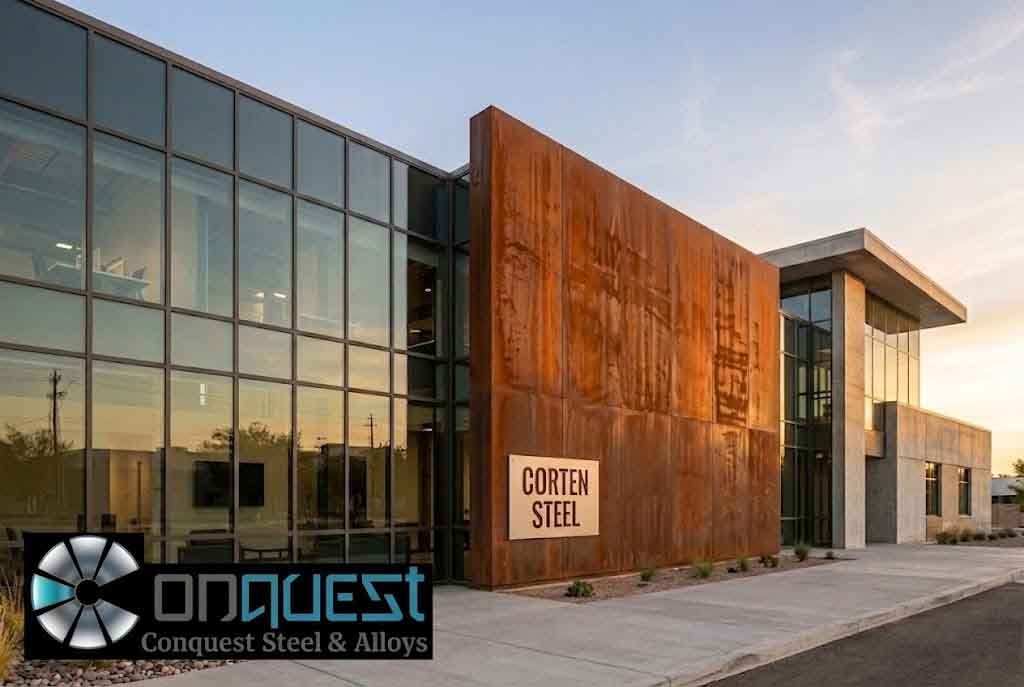
Corten Steel: Properties, Uses & Benefits | Conquest Steel
- Rohit Bisht
Corten Steel Manufacturers & Suppliers in India Since 2008 - Conquest Steel Alloys
Corten steel is no ordinary material. It is a high-strength, self-protecting weathering steel that forms a stable, rust-like patina — eliminating the need for painting, coating, or heavy maintenance throughout its entire service life. Architects choose it for its living, evolving surface. Engineers trust it for its superior yield strength of 355 MPa. Developers value it for its significantly lower lifecycle cost compared to painted or galvanised steel alternatives. From building facades and bridges to landscaping structures and public sculptures, Corten steel delivers where it matters — structurally, visually, and economically. However, smart specification matters. Proper drainage, correct grade selection, suitable environment assessment, and right installation practices determine how well your Corten steel performs over decades. At Conquest Steel & Alloys, we supply certified Corten A and Corten B with full technical support — helping every project get the best out of this extraordinary material.
What Is Corten Steel?
Corten steel is a group of high-strength, low-alloy steel that forms a stable, rust-like patina when exposed to weather. Instead of corroding and weakening the way ordinary steel does, Corten steel develops a protective oxide layer on its surface. This layer seals the steel from further corrosion, making it one of the most durable and low-maintenance structural materials available today.
The name "Corten" is a portmanteau of two key properties — Corrosion resistance and Tensile strength. It is also widely known as weathering steel, atmospheric corrosion-resistant steel, or COR-TEN steel. At Conquest Steel & Alloys, we supply premium-grade Corten steel to architects, engineers, fabricators, and industrial buyers across India. Our expertise in steel alloys gives us the depth to explain not just what Corten steel is, but everything you need to know before you buy, specify, or use it.
A Brief History of Corten Steel
Corten steel was first developed and patented by the United States Steel Corporation in 1933. It was originally engineered for railway coal wagons where bare, unpainted steel needed to resist weathering without constant maintenance. By the 1960s, architects and designers discovered its unique, earthy aesthetic qualities. The weathered orange-brown surface became a design statement in itself. The iconic Cor-Ten sculptures by American artist Richard Serra brought the material into the world of public art, and the material's fame only grew from there. Today, Corten steel is a globally recognized material used in construction, landscaping, architecture, bridges, and industrial applications. In India, its use has grown significantly over the last decade as the construction sector seeks materials that combine structural strength with visual identity.
How Does Corten Steel Work? The Science Behind the Patina
This is where Corten steel separates itself from every other form of steel. When ordinary mild steel is exposed to moisture and oxygen, it starts to rust. The rust is porous and keeps absorbing moisture, causing the steel to corrode deeper and deeper until the metal fails. There is no self-protection mechanism. Corten steel works differently. It contains specific alloying elements — copper, chromium, nickel, phosphorus, and silicon — in small but precise quantities. These elements chemically modify the oxide layer that forms on the surface. Instead of the loose, flaky rust that ordinary steel produces, Corten develops a dense, adherent, and highly stable patina. This patina bonds tightly to the surface of the steel. It becomes a physical barrier between the metal and the environment, blocking moisture and oxygen from penetrating further. Over time, the patina actually becomes more protective, not less. The corrosion process essentially stops itself. The patina color evolves from bright orange to deep reddish-brown to a refined, dark umber over several years depending on the climate and weather cycle frequency.
Chemical Composition of Corten Steel
Understanding the composition helps engineers and buyers verify that what they receive meets specification. Corten steel is manufactured in two primary grades:
COR-TEN A (Corten A)
This grade is used for light structural applications, roofing, cladding, and decorative purposes. Its composition includes:
Carbon (C): max 0.12%, Manganese (Mn): 0.20–0.50%, Phosphorus (P): 0.07–0.15%, Sulphur (S): max 0.030%, Silicon (Si): 0.25–0.75%, Copper (Cu): 0.25–0.55%, Chromium (Cr): 0.50–1.25%, Nickel (Ni): max 0.65%
COR-TEN B (Corten B)
This grade is used for heavy structural applications including bridges, heavy plate work, and structural beams. It is the more widely used grade in industrial and construction contexts.
Carbon (C): max 0.19%, Manganese (Mn): 0.80–1.25%, Phosphorus (P): max 0.035%, Silicon (Si): 0.30–0.65%, Copper (Cu): 0.25–0.40%, Chromium (Cr): 0.40–0.65%, Nickel (Ni): 0.40–0.70%, Vanadium (V): 0.02–0.10%
At Conquest Steel & Alloys, we stock and supply both Corten A and Corten B in plates, sheets, coils, and custom-cut sizes as per project requirements.
Mechanical Properties of Corten Steel
One reason Corten steel is trusted by structural engineers is its superior mechanical performance compared to ordinary carbon steel.
Yield Strength: 355 MPa minimum (compared to ~250 MPa for standard mild steel), Tensile Strength: 470–630 MPa, Elongation: 20% minimum, Impact Toughness: Excellent at sub-zero temperatures, Hardness (Brinell): approximately 150–180 HB
These properties make Corten steel not just a visually distinctive material but a structurally robust one. It handles load-bearing, impact, and stress with high efficiency.
Why Choose Corten Steel? Top Reasons | Conquest Steel & Alloys
Find out why engineers, architects & developers prefer Corten Steel. Lower lifecycle costs, zero maintenance & unmatched strength. Get expert supply from Conquest Steel & Alloys.
Choosing a structural or architectural material is not just about aesthetics. It is about performance over time, cost over the full project life, reliability under environmental stress, and the confidence that comes from knowing your material will not fail you five years down the road.
Here is why Corten steel earns that confidence.
It Protects Itself Without Any Help From You
The single most powerful reason to choose Corten steel over any other carbon steel is its ability to protect itself. When Corten is exposed to rain, humidity, and oxygen, it forms a dense, tightly bonded patina layer on its surface. This layer is chemically different from ordinary rust. It does not flake, peel, or spread inward. It seals the steel beneath it from further corrosion.
Think of it as the material developing its own permanent armour. No paint. No zinc coating. No chemical treatment required. The steel generates its own long-term protection through a natural electrochemical process driven by its alloying elements — copper, chromium, nickel, phosphorus, and silicon.
No other carbon steel does this. That is a hard engineering fact.
It Delivers a Lower Lifecycle Cost Than Painted Steel
The upfront price of Corten steel is higher than mild steel. That is true. But the upfront price is only one part of the cost equation. The full picture includes the cost of protection, the cost of maintenance, and the cost of downtime for repainting or recoating over the decades of service.
Standard painted steel structures require repainting every 5 to 10 years depending on environment. Each repainting cycle involves surface preparation, scaffolding, labour, materials, and project disruption. Over 30 years, those costs compound significantly.
Corten steel eliminates all of that. Once the patina stabilises — typically within 18 to 36 months of outdoor exposure — the structure demands no further surface treatment for the rest of its service life. Engineers who calculate total cost of ownership almost always find that Corten is the more economical choice over any project life beyond 15 years.
It Is Structurally Superior to Standard Carbon Steel
Corten steel is not just a prettier version of mild steel. It is a stronger one. Its minimum yield strength of 355 MPa significantly exceeds the 250 MPa of standard mild steel. This means structural engineers can specify thinner sections of Corten to carry the same load, reducing the total weight of steel required on a project. Lighter structures mean smaller foundations, lower material costs, and faster construction.
For bridge engineers and heavy structural designers, this strength advantage translates directly into project economies and improved structural efficiency.
It Has a Proven Track Record Spanning Over 90 Years
Corten steel was first developed in 1933. It has been used in real-world structural and architectural applications since the 1960s. Bridges built with Corten steel in the United States and Europe in the 1960s are still standing today in sound structural condition, with no significant maintenance intervention in their service lives.
That is not a laboratory claim. It is documented, real-world performance over more than half a century. When you choose Corten steel, you choose a material whose longevity has already been proven in harsh climates and demanding structural environments.
It Is Genuinely Sustainable
In an era where every industry is being asked to reduce its environmental footprint, Corten steel offers a genuinely sustainable choice. Because it requires no paints, coatings, or chemical surface treatments during its service life, it generates no volatile organic compound emissions and no coating waste. At end of life, Corten steel is 100% recyclable with no degradation in material quality. For projects seeking green building certifications or sustainability benchmarks, Corten steel contributes positively to those targets.
It Gives Architects and Designers a Material With a Living Surface
No manufactured coating ages like Corten steel. The patina evolves from bright orange to amber to deep reddish-brown to a rich, dark umber over years of exposure. The surface develops depth and texture that is impossible to replicate with paint or composite cladding. For architects who want their buildings and structures to respond to their environment rather than resist it, Corten steel is the only structural material that genuinely does this.
Key Properties and Advantages of Corten Steel
1. Self-Healing Corrosion Protection The patina layer regenerates itself when damaged. Scratches and surface cuts re-stabilize with continued weather exposure, which is something no paint or coating can replicate.
2. Reduced Maintenance Costs Painted steel requires periodic repainting every 5–10 years. Corten steel requires no painting, no coating, and no maintenance once the patina has fully developed, typically within 18–36 months of outdoor exposure.
3. High Strength-to-Weight Ratio Because of its high yield strength, engineers can specify thinner sections of Corten compared to mild steel while achieving the same structural performance. This saves material costs and reduces dead load.
4. Long Service Life In typical outdoor environments, properly specified Corten steel has a design service life exceeding 100 years without structural degradation. Many Corten bridges in Europe built in the 1960s are still in excellent condition today.
5. Aesthetic Appeal The warm, evolving rust-toned surface makes Corten one of the few structural materials that architects and landscape designers actively choose for its beauty. No other steel looks like this.
6. Weldability Corten steel welds well using standard welding methods including MIG, TIG, and SMAW. Matching Corten welding electrodes are available to ensure the weld area develops the same patina as the parent material.
7. Eco-Friendly and Sustainable Because Corten requires no surface coatings or chemical treatments during its service life, it generates significantly less environmental waste. It is also 100% recyclable at end of life.
Limitations of Corten Steel — What You Should Know Before Buying
A trusted supplier tells you both sides. Here are the honest limitations of Corten steel:
Not Suitable for Permanently Wet or Submerged Environments Corten's protective patina requires a wet-dry cycle to develop and stabilize. If the steel stays permanently wet, as in underwater applications or in areas with poor drainage and constant moisture retention, it will corrode continuously without ever forming the protective layer.
Initial Rust Run-Off Staining During the first 1–3 years while the patina is forming, rainwater running off Corten can leave orange stains on adjacent materials such as concrete, paving, or masonry. Designers must account for this with proper detailing and drainage planning.
Not Ideal for Marine or High-Chloride Environments Chloride ions found near coastlines and marine environments can disrupt the patina formation process and accelerate corrosion. Corten is generally not recommended within 1 km of salt water without additional protective measures.
Higher Initial Cost Than Mild Steel Corten steel costs more than standard carbon steel per tonne. However, when the full lifecycle cost is calculated, including the elimination of painting, coating, and maintenance over 20–50 years, Corten typically delivers a significantly lower total cost of ownership.
Where Is Corten Steel Used? Applications Across Industries
Corten steel is one of the most versatile materials in modern construction and design. Here is where you will find it in active use:
Architecture and Building Facades Corten cladding panels are used on commercial buildings, museums, cultural centres, and residential projects to create a distinctive, textured exterior. The material ages beautifully over time, making the building look richer, not older.
Bridges and Structural Engineering Hundreds of highway and railway bridges worldwide are built with Corten steel. The material's high strength and self-protecting nature make it ideal for infrastructure with minimal maintenance access.
Landscaping and Garden Design Corten planters, retaining walls, edging strips, garden bed borders, raised beds, and water features are now popular across residential and commercial landscaping projects in India. The warm tones of Corten blend naturally with stone, wood, and greenery.
Public Art and Sculpture Artists and sculptors choose Corten for large-scale outdoor installations. The material requires no additional finishing and develops a unique surface character that changes with the seasons.
Shipping Containers and Rail Wagons This is where Corten started. It remains the standard material for freight containers and coal wagons where weather resistance and durability are essential.
Signage and Wayfinding Laser-cut or plasma-cut Corten panels are used for building signage, address markers, and wayfinding boards. The visual depth of the patina makes cut letters and designs stand out dramatically.
Industrial Storage Tanks and Silos Corten's combination of strength and corrosion resistance makes it suitable for industrial storage applications where painted steel would require frequent maintenance.
Roofing and Cladding Sheets In both industrial and architectural applications, Corten roofing sheets offer a long-lasting, weather-resistant alternative to galvanised or painted profiles.
Why Everyone Prefers Corten Steel — The Perspective of Every Stakeholder
Different professionals choose Corten steel for different reasons. Here is why virtually every discipline involved in construction and design has arrived at the same preference.
Why Structural Engineers Prefer Corten Steel
Structural engineers value materials that perform predictably under load and over time. Corten steel gives them high yield strength, excellent impact toughness, and reliable corrosion resistance with a well-documented performance history. The ability to reduce section sizes while maintaining structural performance is a technical and economic advantage that engineers appreciate on every project.
Corten also welds well using standard welding procedures, and structural connections behave consistently with standard bolt and weld specifications. It does not require engineers to learn a new design methodology. Corten fits within existing structural steel design codes across ASTM, IS, and EN standards.
Why Architects Prefer Corten Steel
Architects choose Corten because it is one of the very few structural materials that improves visually with age. A painted facade eventually looks tired. A glass curtain wall needs constant cleaning. Corten steel develops character. The warm tones of the patina create a visual warmth and depth that resonates powerfully in both natural and urban contexts.
Corten also offers design flexibility. It can be cut with precision using laser or plasma processes into intricate shapes, screens, panels, and perforated designs. It can be used as a flat cladding panel, a curved facade element, a textured wall, or a structural frame. Few other materials offer the same range of architectural expression.
Why Landscape Designers and Garden Architects Prefer Corten Steel
In landscaping, Corten has become the dominant choice for raised garden beds, planters, retaining walls, pond edging, garden borders, and decorative screens. The earthy rust tones of Corten blend naturally with soil, stone, timber, and green planting in ways that painted steel or plastic alternatives never can. Landscape designers also value the fact that Corten in garden applications requires no seasonal maintenance, no repainting, and no protective spraying. It simply performs and ages beautifully.
Why Project Developers and Owners Prefer Corten Steel
Developers and owners focus on value over the full project life, not just construction cost. Corten steel reduces the maintenance budget for the life of the asset. It reduces the risk of structural degradation due to corrosion failure. It increases the design life of the structure. And it provides a distinctive visual identity that adds perceived and real value to the asset. For commercial buildings, public infrastructure, and premium residential developments, these are compelling financial and reputational advantages.
Why Fabricators and Contractors Prefer Corten Steel
From a fabrication standpoint, Corten steel works with standard workshop equipment and processes. It cuts, bends, rolls, and welds using tools and techniques already familiar to any steel fabricator. No specialist equipment is required. Corten welding consumables that match the parent metal's alloying composition are readily available, ensuring weld areas develop the same patina as the parent plate. For contractors, the elimination of a post-installation painting or coating programme simplifies project completion and reduces the risk of coating-related defects and warranty claims.
Corten Steel vs. Other Steels: How Does It Compare?
Corten Steel vs. Mild Steel Mild steel is cheaper upfront but requires protective coatings and regular maintenance. Corten self-protects, offers higher strength, and delivers a lower lifecycle cost. For outdoor applications, Corten wins on every metric except initial price.
Corten Steel vs. Stainless Steel Stainless steel resists corrosion through a chromium oxide layer but is significantly more expensive than Corten. Stainless steel does not develop a patina and remains bright silver. Corten is preferred in architectural and landscape contexts where a warm, earthy visual tone is desired. For food processing or pharmaceutical applications, stainless steel remains the choice.
Corten Steel vs. Galvanised Steel Galvanised steel is zinc-coated mild steel. The zinc coating protects against corrosion but can be scratched, and the protection is finite. Galvanised steel cannot match Corten's service life in most outdoor environments. However, galvanised is preferred in coastal environments where Corten is not recommended.
How Long Does Corten Steel Last?
In ideal conditions — alternating wet and dry weather cycles, moderate humidity, no permanent water accumulation, and no high-chloride environment — Corten steel can last well over 100 years without any structural maintenance. This is a claim backed by real-world evidence from bridges, buildings, and art installations that have been standing since the 1960s and 1970s.
The patina typically stabilises within 18 to 36 months. Once stable, the surface remains visually consistent and structurally intact for decades.
Corten Steel Maintenance Tips — Keep It Rust-Ready Always
Learn how to maintain Corten Steel the right way. From drainage tips to annual inspection — protect your investment with expert guidance from Conquest Steel & Alloys, India.
Maintenance Tips for Corten Steel — How to Keep It Performing at Its Best
One of the most common misconceptions about Corten steel is that it needs zero attention. The reality is more nuanced. Corten steel requires dramatically less maintenance than painted or galvanised steel, but it does benefit from some straightforward periodic care, particularly in the early years of patina development. Here is what you need to do.
Allow the Patina to Form Naturally — Do Not Interfere
In the first 18 to 36 months, the patina is forming and stabilising. During this period, do not clean the surface with abrasive tools, wire brushes, or chemical cleaners. Do not paint over the emerging patina. Do not seal it prematurely. The patina forms through a natural chemical process that requires oxygen, moisture, and time. Any interference during this period can disrupt the process and result in an uneven or poorly bonded protective layer.
Ensure Good Drainage and Airflow Around the Steel
The wet-dry cycle is essential to healthy patina development. If water pools against a Corten surface and cannot drain or evaporate, the steel remains permanently wet. In this condition, the patina cannot form or stabilise, and active corrosion will continue indefinitely.
Always detail Corten installations with adequate drainage. Avoid designs where water is trapped behind the steel or where leaves and debris can accumulate against the surface and hold moisture. Ensure there is airflow around Corten sections wherever possible.
Inspect Joints, Welds, and Connections Annually
While the open face of Corten steel is self-protecting, joints, overlaps, and mechanical connections are potential sites for moisture retention and crevice corrosion. During the annual inspection, check that no water is trapped in joints or behind connection plates. Clear any debris from crevices and ensure drainage paths at connections remain open.
Monitor Areas in Contact With Concrete or Masonry
Where Corten steel meets concrete, masonry, or stone, there is a risk of staining from iron oxide wash-off during the early patina formation years and a risk of moisture being retained at the interface. Inspect these contact zones annually and ensure any design detailing that was intended to allow drainage is still functioning as intended.
Manage Vegetation Clearance
In landscaping applications, plant roots and leaf litter can hold moisture against Corten surfaces and create localised permanent wet zones. Trim plants and clear debris from around Corten garden structures, raised beds, and retaining walls at least twice a year.
Check for Mechanical Damage
Impacts from equipment, vehicles, or construction activity can scratch or gouge the Corten surface and expose bare steel. In most cases, the patina will regenerate across scratches naturally with continued weather exposure. For deeper gouges or areas of localised damage in critical structural sections, consult a structural engineer and consider a compatible Corten-matched touch-up or weld repair.
In Coastal or High-Chloride Areas, Increase Inspection Frequency
If you have installed Corten steel in an environment closer to the coast than originally recommended, or in an industrial area with atmospheric pollutants, increase your inspection frequency to twice a year. Look for signs of uneven patina, soft or flaking corrosion, or localised pitting, which can indicate that the protective patina is not performing as expected.
Do Not Use Acid-Based Cleaners
If you need to remove surface debris, biological growth, or staining from the Corten surface, use only plain water and a soft brush or cloth. Never use acid-based cleaners, bleach, or abrasive chemical products. These will damage the patina and can accelerate corrosion by chemically attacking the protective oxide layer.
Pre-Weathered Corten: Maintenance Considerations
If your Corten steel has been supplied with an artificially accelerated, pre-weathered patina finish, the maintenance requirements are the same as naturally weathered steel. The pre-weathered finish is chemically identical to naturally formed patina. It should be treated with the same care, the same drainage awareness, and the same periodic inspection discipline.
Corten Steel Do's & Don'ts — Avoid Costly Mistakes | Conquest
Before you install Corten Steel, know what to do and what to avoid. Our expert guide covers every critical rule to protect performance, patina & structural integrity long-term.
Do's and Don'ts With Corten Steel — The Rules That Protect Your Investment
Every material has rules. Respecting them is the difference between a structure that performs for a hundred years and one that causes problems within five. Here are the definitive do's and don'ts for anyone working with or specifying Corten steel.
THE DO'S
Do specify Corten steel for outdoor applications with regular wet-dry weather cycles. This is the environment in which it performs at its absolute best.
Do allow adequate drainage in all design details. Corten steel thrives when water moves across its surface and then dries. Detail every joint, ledge, and horizontal surface to prevent water retention.
Do use matching Corten welding consumables when fabricating or joining Corten sections. Standard mild steel welding rods will not develop the same patina as the parent metal, leaving weld areas visually distinct and potentially less corrosion resistant.
Do apply a clear sealer or locking oil if you want to fix the patina at a specific colour stage, for example in an interior application or in a climate where natural patina cannot form properly. This seals the colour and prevents further colour change while still protecting the surface.
Do inform adjacent material suppliers and designers about the orange iron oxide run-off that will occur during the early patina formation period. This run-off will stain concrete, paving, timber, and other porous surfaces in the immediate vicinity. Plan drainage, protective covers, or sacrificial surface treatments accordingly.
Do store Corten steel correctly before installation. Keep it off the ground, under cover where possible, and ensure air can circulate around stored sections. This prevents uneven or accelerated surface reactions before installation.
Do use stainless steel fasteners when connecting Corten steel panels or sections. Standard mild steel bolts and screws will corrode rapidly in the galvanic environment created by the Corten patina. Stainless steel fasteners remain stable and avoid unsightly streaking from fastener corrosion.
Do conduct annual visual inspections of all Corten installations, paying particular attention to drainage zones, joints, and contact points with concrete or masonry.
Do consult a qualified structural engineer and your Corten steel supplier before using this material in any application outside its standard recommended parameters.
THE DON'TS
Do not use Corten steel in permanently wet or submerged environments. Fully submerged steel, steel in contact with permanently standing water, or steel in applications where moisture cannot evaporate will corrode continuously without ever forming the protective patina. This is the most critical rule.
Do not install Corten steel within 1 kilometre of a coastline or in marine environments with high chloride concentrations without specialist advice and additional protective measures. Chloride ions interfere with the patina chemistry and can cause localised corrosion that the self-protection mechanism cannot arrest.
Do not paint over Corten steel unless there is a specific design or engineering reason to do so. Painting defeats the purpose of specifying a self-protecting material and creates a maintenance liability that did not previously exist.
Do not allow debris, leaf litter, soil, or vegetation to build up against Corten steel surfaces. These materials retain moisture and create permanently wet zones that prevent proper patina formation.
Do not allow Corten steel run-off to flow onto architectural concrete, decorative paving, or natural stone without protective drainage measures. The iron oxide staining produced during patina formation is extremely difficult to remove from porous surfaces.
Do not use Corten steel in indoor applications without sealing. Without regular outdoor weather cycling, the patina will not stabilise, and the surface will continue to produce iron oxide dust. In interior environments, always seal the surface with a clear lacquer or penetrating oil to fix the finish.
Do not assume all weathering steels are equal. Different grades (Corten A and Corten B) are designed for different applications. Using the wrong grade for your structural requirement can result in underperformance. Always specify the correct grade with your supplier.
Do not use Corten steel in contact with galvanised steel or zinc-coated components. The contact between the two materials creates a galvanic couple that accelerates corrosion of the zinc coating, eventually leaving the adjacent steel unprotected.
Do not ignore signs of uneven patina, localised pitting, or unusual discolouration during inspections. These can be early indicators of an installation or environmental condition that is preventing proper patina development. Address them early before they develop into structural issues.
How to Specify Corten Steel: Standards and Grades
When purchasing Corten steel, reference the correct international standard for your application:
ASTM A242 and ASTM A588 — American standards for structural weathering steel, EN 10025-5 — European standard for structural steel with improved atmospheric corrosion resistance, IS 2062 Grade E350 BR — Indian standard equivalent for weathering structural steel, JIS G3125 — Japanese standard for atmospheric corrosion-resisting steel
At Conquest Steel & Alloys, we supply Corten steel compliant with ASTM, EN, IS, and JIS standards with full mill test certificates and material traceability documentation.
Corten Steel Finishes and Forms Available
Corten steel is available in multiple product forms to suit different applications:
Hot-rolled plates and sheets are used for structural and heavy fabrication applications. Cold-rolled sheets are used for precision fabrication, cladding, and decorative work. Corten coils are used for profiling, roofing, and cladding manufacturers. Corten structural sections including beams, angles, and channels are available for structural frame applications. Custom laser-cut or plasma-cut Corten blanks can be produced to your drawings and dimensions.
Surface finish options include natural mill finish (which will weather to patina over time), pre-weathered finish (artificially accelerated patina for immediate installation), brushed finish, and sealed finish (with clear coat to lock in the patina at a specific stage of weathering).
How to Buy Corten Steel From Conquest Steel & Alloys
Conquest Steel & Alloys is one of India's trusted suppliers of specialty and high-performance steel, including Corten weathering steel grades. Here is what sets us apart:
We maintain ready stock of Corten A and Corten B in standard and non-standard sizes. We offer competitive pricing with transparent quotations. Our team provides technical guidance on grade selection, application suitability, and specification compliance. We supply with mill test certificates, chemical and mechanical test reports, and full material traceability. We can arrange custom cutting, profiling, and fabrication services for your specific project needs. We serve architects, structural engineers, fabricators, contractors, and direct buyers across India.
Whether you need a single plate for a garden project or multi-tonne quantities for a structural or infrastructure contract, we have the inventory and expertise to fulfill your requirement reliably.
Corten Steel Buying Guide — Key Factors to Consider | Conquest
Planning to use Corten Steel? Check climate, drainage, grade & budget first. Conquest Steel & Alloys helps you spec the right weathering steel for every project across India.
Factors to Consider Before Using Corten Steel — Your Pre-Project Checklist
Before you commit to Corten steel on any project, work through the following factors carefully. This checklist is what experienced engineers, architects, and procurement specialists at Conquest Steel & Alloys advise every client to address before placing an order.
1. Environment and Climate
Corten steel performs best in environments with regular, alternating wet and dry weather cycles. Evaluate the climate of your project location honestly. Does it receive reliable rainfall followed by dry periods? If so, Corten is well suited. Is the environment permanently humid with no dry periods? Is it semi-arid with very rare rain? Both extremes can slow or prevent proper patina formation and should be discussed with a technical specialist before proceeding.
2. Proximity to Coastal or Industrial Areas
Confirm the distance from your project site to the coast. As a general rule, Corten steel should not be used in open, exposed outdoor applications within 1 kilometre of salt water. High concentrations of atmospheric chlorides disrupt the patina chemistry. Similarly, industrial environments with high concentrations of sulphur dioxide, ammonia, or other aggressive atmospheric pollutants can affect Corten's performance and should be evaluated before specification.
3. Drainage and Detailing Feasibility
Review your design carefully with drainage in mind before specifying Corten. Horizontal surfaces where water can pool, box sections that can trap water, and closed cavities behind Corten cladding panels are all design conditions that need to be resolved before installation. If the design cannot accommodate adequate drainage without significant changes, reconsider the material choice or redesign the drainage strategy.
4. Adjacent Materials and Staining Risk
Identify every material that will be in proximity to the Corten steel, particularly below it and downstream of any drainage paths. Concrete floors, decorative paving, natural stone, timber decking, and architectural finishes are all vulnerable to iron oxide staining during the patina formation period. Assess whether staining of these materials is acceptable, manageable, or a project risk that needs to be mitigated through detailing or phased construction.
5. Structural Grade and Standard
Confirm whether your application requires Corten A or Corten B. Heavy structural applications including bridges, structural frames, and load-bearing connections require Corten B, which conforms to standards such as ASTM A588, EN 10025-5, or IS 2062 Grade E350 BR. Lighter architectural and cladding applications may be satisfied by Corten A. Specifying the wrong grade can result in a material that does not meet the structural design requirements. Always confirm grade selection with both your structural engineer and your steel supplier.
6. Interior Versus Exterior Application
Are you using Corten steel indoors, outdoors, or in a partially sheltered location such as a covered walkway or semi-enclosed courtyard? Interior and sheltered applications require a sealed or pre-weathered finish because the steel will not have enough outdoor weather exposure to develop and stabilise its patina naturally. Unsettled, active patina in an interior space produces iron oxide dust that transfers to clothing and surfaces. Always seal interior Corten applications.
7. Fabrication and Connection Details
Confirm with your fabricator that they have experience with Corten steel and access to matching Corten welding consumables. Review all connection details and confirm that fasteners specified are stainless steel grade A4 or equivalent. Verify that no galvanised components are in direct metal-to-metal contact with Corten sections. These are fabrication and connection details that are easy to get right at the design stage and difficult to correct after installation.
8. Budget and Lifecycle Cost Analysis
Compare the full lifecycle cost of Corten steel against your alternative material options, not just the upfront purchase price. Factor in the cost of paint and coating systems for alternative materials, the frequency and cost of repainting cycles over the expected project life, the scaffolding and access costs associated with maintenance, the risk cost associated with coating failure and structural exposure, and the residual or scrap value of the material at end of life. In most cases, this analysis will confirm that Corten steel is the most economical structural material choice for outdoor applications with a design life beyond 15 years.
9. Planning, Regulatory, and Heritage Approvals
In some municipalities and heritage zones in India and internationally, the use of weathering steel in visible external applications requires planning approval or design review. The russet tones and weathered appearance of Corten are not universally accepted in all regulatory or heritage contexts. Confirm with your planning authority before specifying Corten in sensitive design zones.
10. Supplier Quality and Certification
Corten steel must meet verified chemical and mechanical specifications to perform as intended. The alloying element percentages are critical. Steel that does not meet specification will not develop a stable patina and will behave as ordinary corroding steel. Always purchase Corten steel from a supplier who provides full mill test certificates, chemical composition reports, and mechanical test data for every batch supplied.
At Conquest Steel & Alloys, every Corten steel product we supply comes with complete material certification, traceability to the originating mill, and technical support from our team to help you specify and apply the material correctly.
Corten Steel Price in India - Conquest Steel & Alloys
If you are searching for Corten steel prices in India, you already know one thing — this is not a commodity material where you can find a fixed rate on a price board and place an order without thinking. Corten steel pricing depends on grade, form, thickness, quantity, mill source, and market conditions. Getting the wrong information before you buy can cost you significantly, either in overpaying or in receiving material that does not meet your specification.
This guide gives you everything you need to understand Corten steel pricing in India in 2025 — what drives the price, what the current market rate range looks like, how to compare quotes correctly, and how to ensure you are buying certified, specification-compliant material at a fair and competitive price.
At Conquest Steel & Alloys, we supply Corten steel to architects, structural engineers, fabricators, contractors, landscapers, and industrial buyers across India. We do not believe in hiding pricing behind a phone call. We believe in educating our buyers so they make confident, informed decisions.
What Is the Current Corten Steel Price in India in 2025?
Corten steel prices in India in 2025 range approximately as follows based on current market conditions, import parity pricing, and domestic mill rates:
Corten Steel Plates and Sheets (Hot Rolled) Thickness 3mm to 6mm: approximately ₹85 to ₹100 per kg Thickness 6mm to 12mm: approximately ₹80 to ₹95 per kg Thickness 12mm to 25mm: approximately ₹78 to ₹92 per kg Thickness 25mm and above: approximately ₹75 to ₹90 per kg
Corten Steel Coils (Hot Rolled) Thickness 2mm to 6mm: approximately ₹82 to ₹98 per kg
Corten Steel Cold Rolled Sheets Thickness 0.5mm to 3mm: approximately ₹95 to ₹115 per kg
Corten Steel Structural Sections (Beams, Angles, Channels) Price on application based on section size and quantity — typically ₹80 to ₹100 per kg
Pre-Weathered Corten Steel (Artificially Patinated Finish) Premium of approximately ₹15 to ₹30 per kg over standard mill finish pricing
These are indicative market rate ranges as of 2025. Actual prices depend on quantity ordered, delivery location, applicable GST, freight charges, and current steel market conditions. Contact Conquest Steel & Alloys for a precise, project-specific quotation.
Why Does Corten Steel Cost More Than Mild Steel?
This is the first question every new buyer asks. The honest answer is that Corten steel costs more than standard mild steel for legitimate, measurable reasons — not because suppliers are applying an arbitrary premium.
Alloying Element Cost Corten steel contains copper, chromium, nickel, phosphorus, and silicon in precisely controlled quantities. These alloying elements are more expensive than the iron and carbon that form the bulk of standard mild steel. The raw material cost of producing Corten is therefore higher from the very first stage of the steelmaking process.
Controlled Manufacturing Process Producing Corten steel to specification requires tighter process controls than standard carbon steel. Chemical composition must be precisely maintained within narrow ranges to ensure the patina chemistry works correctly in service. Mill testing, chemistry verification, and quality control are more rigorous and therefore more costly.
Lower Production Volume Corten steel is a specialty product. It is produced in smaller volumes than commodity structural steel. Lower production volumes mean higher unit costs at the mill level, which flows through the entire supply chain to the end buyer.
Import Dependency in India India has limited domestic production of certified Corten steel to international standards such as ASTM A588 and EN 10025-5. A significant portion of Corten steel sold in India is imported from mills in South Korea, Japan, Europe, and China. Import costs including ocean freight, customs duty, port handling, and inland logistics add to the landed cost in India.
The Total Cost Argument While Corten steel costs ₹20 to ₹40 per kg more than equivalent mild steel at the point of purchase, it eliminates the cost of painting, coating, and maintenance over the entire life of the structure. For a structure with a 30-year design life, the total cost of ownership of Corten steel is typically lower than painted mild steel even after accounting for the higher upfront material cost. Experienced engineers and project developers understand this calculation well.
Corten Steel Price Factors in India — What Drives the Rate
Understanding what drives Corten steel pricing helps you interpret quotes, compare suppliers accurately, and negotiate from a position of knowledge. Here are every key factor that influences the price you pay in India.
1. Grade — Corten A vs Corten B Corten B is the more widely used and more widely stocked grade in India. It is used for heavy structural applications and conforms to ASTM A588, EN 10025-5, and IS 2062 Grade E350 BR. Corten A has a higher phosphorus content and is used in lighter architectural and cladding applications. Pricing between the two grades is broadly similar, but availability and lead times can differ depending on the supplier's stock position.
2. Product Form Hot rolled plates and sheets are the most competitively priced form of Corten steel because they are the most commonly produced and stocked. Cold rolled sheets command a premium due to the additional processing involved and the tighter dimensional tolerances achieved. Structural sections are priced based on section weight, rolling costs, and availability. Pre-weathered or artificially patinated Corten carries a surface treatment premium.
3. Thickness Thinner gauges of Corten steel, particularly below 3mm, carry a thickness premium because they require additional processing precision. Heavier plates above 25mm may also carry a premium due to lower demand and stocking levels. The most competitively priced range is typically 6mm to 20mm hot rolled plate, which represents the highest volume of demand in India.
4. Quantity Ordered Like all steel products, Corten steel pricing improves with quantity. Single plate or small quantity orders will be priced at a higher per-kg rate than full mill bundle quantities, container lot orders, or multi-tonne project supply contracts. If your project requires significant tonnage, discuss volume pricing directly with your supplier.
5. Mill Source and Certification Corten steel from reputed international mills with full ASTM, EN, or IS certification commands a premium over uncertified or grey market material that circulates in the Indian market without verified chemistry or mechanical test documentation. Certified material costs more. It is also the only material that you can genuinely rely on to perform as Corten steel should. The price difference between certified and uncertified material is real but it represents the cost of certainty.
6. Cut-to-Size vs Standard Mill Size Standard mill size plates and sheets are priced at the base market rate. Custom cut-to-size, laser-cut profiles, plasma-cut shapes, or value-added processing such as bending, rolling, or perforating carry additional fabrication charges on top of the base material price. These charges vary by processor and complexity of the work required.
7. Delivery Location and Freight Steel is heavy. Freight costs are a material component of the landed price at your project site or fabrication yard. Buyers in Mumbai, Pune, Delhi, Ahmedabad, and Chennai are closer to major steel distribution hubs and port entry points, and typically pay lower freight costs than buyers in remote locations. Always confirm whether a quoted price is ex-works, including freight to your location, or including GST and freight.
8. Market Conditions and International Steel Prices Global steel prices are influenced by iron ore prices, coking coal prices, energy costs, and demand cycles in major steel-consuming economies including China, the United States, and the European Union. When global steel prices rise, Corten steel prices in India rise accordingly, particularly for imported material. Staying aware of broad steel market trends helps you time your purchases intelligently.
9. GST on Corten Steel in India Corten steel in India attracts GST at 18% on the base material value. This is consistent with the GST applicable to most specialty steel products. Always confirm whether the price you are quoted includes or excludes GST, as this significantly affects your budget calculation and procurement planning.
Corten Steel Price Comparison — India vs Import
Many buyers in India source Corten steel through a combination of domestic stock holders and direct imports. Here is how the two routes compare:
Domestically Stocked Corten Steel in India Availability is immediate from stock. No import lead time or shipping delays. Competitive pricing for standard sizes and thicknesses. Full documentation including test certificates is available from reputable stockists. Ideal for project-urgent requirements and smaller quantities. Conquest Steel & Alloys maintains ready stock of Corten steel in standard and popular sizes for immediate supply across India.
Direct Import of Corten Steel Better pricing on large volume orders above 25 to 50 tonnes where the economics of a full container import make sense. Longer lead times of typically 45 to 90 days from order placement to delivery at Indian port. Requires the buyer to manage customs clearance, import duty, port handling, and inland freight independently or through a freight forwarder. For buyers with sufficient volume and lead time flexibility, direct import can reduce the per-kg cost meaningfully.
For most buyers in India — particularly those with project timelines to meet and quantities below full container loads — purchasing from a domestic stockist like Conquest Steel & Alloys offers the better combination of price, reliability, documentation, and delivery speed.
Corten Steel Price in India — City-Wise Market Overview
Steel prices in India are not uniform across the country. Regional demand, proximity to ports, freight costs, and local market competition all influence the price you pay in different cities.
Mumbai Mumbai is one of India's primary steel import and distribution hubs. Access to JNPT and Mumbai Port means competitive landed costs for imported Corten steel. Strong competition among steel traders and stockists keeps pricing competitive. Mumbai buyers typically access some of the most competitive Corten steel pricing in India.
Delhi and NCR Delhi is a major consumption centre for architectural and structural steel. Multiple stockists and traders serve the Delhi NCR market, creating competitive pricing. Inland freight from Mumbai or Kolkata adds to the landed cost compared to port cities, but competitive local distribution partially offsets this.
Pune Pune's proximity to Mumbai Port and its large fabrication and manufacturing sector make it a well-served market for Corten steel. Pricing is broadly similar to Mumbai with modest freight additions depending on the specific delivery point in the Pune region.
Ahmedabad and Gujarat Gujarat's strong industrial and construction sector drives healthy demand for specialty steel. Proximity to Mundra and Kandla ports gives Gujarat buyers good access to imported Corten steel at competitive rates.
Chennai and South India Chennai Port provides direct access to steel imports for South Indian buyers. The growing architectural and infrastructure sector in South India has increased demand for Corten steel significantly in recent years. Pricing is competitive for buyers who can access Chennai-based stockists.
Kolkata and East India Kolkata's proximity to Haldia Port and the strong infrastructure investment in eastern India make it an emerging market for Corten steel. Pricing may carry a modest premium over west coast markets for imported material depending on supply chain routing.
How to Get the Best Corten Steel Price in India — Buyer's Guide
Getting the best price is not just about finding the lowest number in a quote. It is about getting the best value — the right material, at the right specification, with the right documentation, at a fair and competitive market rate, delivered on time. Here is how to achieve that.
Always Specify the Correct Grade and Standard Tell your supplier exactly what grade you need — Corten A or Corten B — and which international standard it should comply with. ASTM A588, EN 10025-5, or IS 2062 Grade E350 BR. Suppliers who quote without asking about grade are not quoting on the same material. Specification clarity protects you from substitution with non-compliant material.
Request Mill Test Certificates With Every Quote Any reputable Corten steel supplier in India will provide Mill Test Certificates with every supply. These certificates confirm the chemical composition and mechanical properties of the material. If a supplier offers a very low price but cannot provide MTCs, the material is likely non-compliant, uncertified, or substituted with standard carbon steel that has been represented as Corten. The cost of building with uncertified material is always higher than the price saved upfront.
Compare Like-for-Like Quotes When you receive multiple quotes, confirm that each is for the same grade, standard, thickness, finish, and quantity. Confirm whether prices include or exclude GST and freight. A quote that appears ₹5 per kg cheaper may actually be more expensive once GST and freight to your site are correctly added.
Buy in Project Quantities Where Possible Consolidate your Corten steel requirement for the full project into a single order wherever your project timeline allows. Volume ordering reduces the per-kg rate and reduces the number of separate deliveries, documentation sets, and logistics arrangements you need to manage.
Build a Supplier Relationship, Not Just a Transaction The best Corten steel prices in India come from established supplier relationships where the supplier understands your typical requirements, your project pipeline, and your quality standards. Suppliers who know your business can give you market timing intelligence, flag stock availability issues before they become problems, and offer preferential pricing on repeat business.
Why Buy Corten Steel From Conquest Steel & Alloys?
Conquest Steel & Alloys is one of India's dedicated specialty and high-performance steel suppliers with deep expertise in Corten weathering steel. Here is what every buyer who works with us receives:
We maintain ready stock of Corten A and Corten B in hot rolled plates, sheets, and coils in a wide range of standard thicknesses for immediate supply. Every Corten steel product we supply comes with full Mill Test Certificates confirming chemical composition and mechanical properties to ASTM, EN, or IS standards. Our pricing is competitive, transparent, and based on current market conditions. We do not apply hidden charges. Our technical team provides grade selection guidance, application suitability advice, and specification support for every project — whether it is a single garden structure or a multi-tonne infrastructure contract. We offer cut-to-size services for buyers who need non-standard dimensions. We serve buyers across India with reliable logistics and documentation support. Whether you are a first-time Corten buyer or an experienced specifier placing your tenth order, we give you the same standard of product quality, documentation, and service.
Every buyer wants a competitive price. That is entirely reasonable. But with a specialty material like Corten steel, price is only one dimension of the decision. The grade must be correct. The certification must be genuine. The chemistry must comply with specification. The supplier must be reliable and accountable. A Corten steel plate that is ₹10 per kg cheaper but is not compliant with ASTM A588 or EN 10025-5 will not develop the protective patina correctly. It will corrode like ordinary steel. The cost of replacing it, rebuilding around it, or defending a structural failure is infinitely more expensive than the saving made at the point of purchase.
At Conquest Steel & Alloys, we supply Corten steel that is correctly specified, fully certified, competitively priced, and backed by technical expertise. We are not the cheapest option in the market. We are the most reliable one. And in the steel business, reliability is always worth more than the lowest number on a quote sheet.
Frequently Asked Questions About Corten Steel
What is Corten steel and why is it different from regular steel?
Corten steel is a high-strength, low-alloy weathering steel that forms a stable, rust-like protective patina when exposed to weather. Unlike regular mild steel, which corrodes and weakens over time, Corten steel's patina acts as a self-renewing barrier that stops further corrosion from penetrating the metal. It requires no paint, no coating, and no chemical treatment to protect itself. That self-protection ability is what makes it fundamentally different from every other carbon steel on the market.
Is Corten steel completely rust-proof?
Corten steel is not rust-proof, but it is corrosion-resistant in a way ordinary steel is not. It deliberately forms a controlled rust-like patina on its outer surface. This patina is dense, stable, and tightly bonded to the steel beneath it. It seals the metal from further moisture and oxygen penetration, stopping the corrosion process from going deeper. So while the surface looks rusty, the steel underneath remains fully intact and structurally sound. This is a critical distinction every buyer must understand before specifying the material.
How long does it take for Corten steel to develop its patina?
In typical outdoor conditions with regular wet and dry weather cycles, Corten steel develops and stabilises its protective patina within 18 to 36 months. The colour evolves from bright orange to amber, then to a deep reddish-brown, and finally settles into a rich dark umber tone over several years. The exact timeline depends on local climate, rainfall frequency, humidity levels, and how much direct weather exposure the steel receives. Drier climates may take longer. Pre-weathered Corten is also available if you need the patina appearance from day one of installation.
Can Corten steel be used near the sea or in coastal areas?
Corten steel is generally not recommended for use within 1 kilometre of a coastline or in environments with high concentrations of airborne salt and chlorides. Chloride ions disrupt the chemical process that allows Corten's patina to form and stabilise. In high-chloride environments, the steel may corrode continuously without ever developing adequate protection. If you are working on a project near the coast, consult a structural engineer and your steel supplier before specifying Corten. Alternative materials or additional protective treatments may be required.
Does Corten steel require painting or any surface coating?
No. One of the primary advantages of Corten steel is that it does not require painting, galvanising, or any surface coating for outdoor structural and architectural applications. The protective patina it forms is its coating. Applying paint over Corten actually defeats its purpose and introduces a maintenance obligation that would not otherwise exist. The only exception is for interior applications or permanently sheltered locations where the steel cannot undergo natural weather cycling. In those situations, a clear sealer or penetrating oil should be applied to lock in the surface finish and prevent active iron oxide dust from transferring to surrounding surfaces.
What is the difference between Corten A and Corten B?
Corten A and Corten B are the two primary grades of weathering steel, each designed for different applications. Corten A has a higher phosphorus content and is used for lighter applications such as roofing sheets, wall cladding, architectural panels, and decorative structures. Corten B has a higher manganese and vanadium content, giving it greater strength and toughness for heavy structural applications such as bridges, structural beams, columns, and load-bearing frameworks. Both grades develop the same characteristic rust-toned patina. Selecting the wrong grade for your application is a specification error that can compromise structural performance, so always confirm the correct grade with your engineer and supplier before ordering.
Is Corten steel more expensive than mild steel?
Corten steel has a higher upfront purchase price per tonne compared to standard mild steel. However, when you calculate the total cost of ownership over the full project life, Corten steel is almost always the more economical choice for outdoor applications. Mild steel requires painting or galvanising at installation, followed by repainting or recoating every 5 to 10 years depending on the environment. Each maintenance cycle adds labour costs, scaffold costs, access costs, and project downtime. Corten steel eliminates all of those ongoing costs. Over a 20 to 30 year project life, the total cost advantage of Corten over painted mild steel is substantial.
Can Corten steel be welded and fabricated like ordinary steel?
Yes. Corten steel welds, cuts, bends, rolls, and forms using standard steel fabrication equipment and techniques already found in any steel workshop. No specialist machinery is required. The important detail is to use matching Corten welding consumables — welding rods and wire specifically formulated with the same alloying elements as Corten steel. This ensures that weld zones develop the same protective patina as the surrounding parent metal over time. Using standard mild steel welding electrodes on Corten will result in weld areas that look visually different and may not achieve the same level of corrosion resistance.
Where is Corten steel commonly used in India?
Corten steel is widely used across India in architectural facades and building cladding, landscaping structures including raised garden beds, planters, and retaining walls, bridges and highway infrastructure, public art installations and sculptures, industrial signage and wayfinding panels, roofing and exterior wall panels, and commercial and residential decorative features. Its use has grown significantly in India over the last decade as architects, landscape designers, and developers discover the combination of structural performance and distinctive visual character that no painted or coated steel can replicate.
How do I buy Corten steel from Conquest Steel & Alloys?
Conquest Steel & Alloys supplies Corten A and Corten B in plates, sheets, coils, and structural sections to buyers across India. We maintain ready stock in standard and non-standard sizes, supply with full mill test certificates and material traceability documentation, and offer technical guidance on grade selection and application suitability at no additional charge. Whether you need a single plate for a residential garden project or multi-tonne quantities for a structural or infrastructure contract, our team is equipped to handle your requirement with accuracy, speed, and full documentation. Contact us directly with your specifications and we will provide a competitive, transparent quotation.
Final Thoughts: Why Corten Steel Is One of the Smartest Materials You Can Specify
Corten steel is not a trend. It is a material with over 90 years of engineering history behind it. It was designed by metallurgists who wanted steel to protect itself, and it does exactly that with remarkable efficiency. For architects, it offers a living, evolving surface that no paint or coating can replicate. For structural engineers, it offers high strength with reduced maintenance obligation. For project owners and developers, it delivers a lower total cost of ownership over the life of the structure. It is rare that a single material satisfies aesthetic, structural, and economic requirements simultaneously. Corten steel does all three. At Conquest Steel & Alloys, we believe that the right material makes every project stronger, more beautiful, and more durable. Corten steel is one of those materials, and we supply it with the quality, documentation, and technical support your project deserves.
Contact Conquest Steel & Alloys today to discuss your Corten steel requirement. Our technical team is available to help you select the right grade, confirm specifications, and provide competitive pricing with complete documentation for your project.


