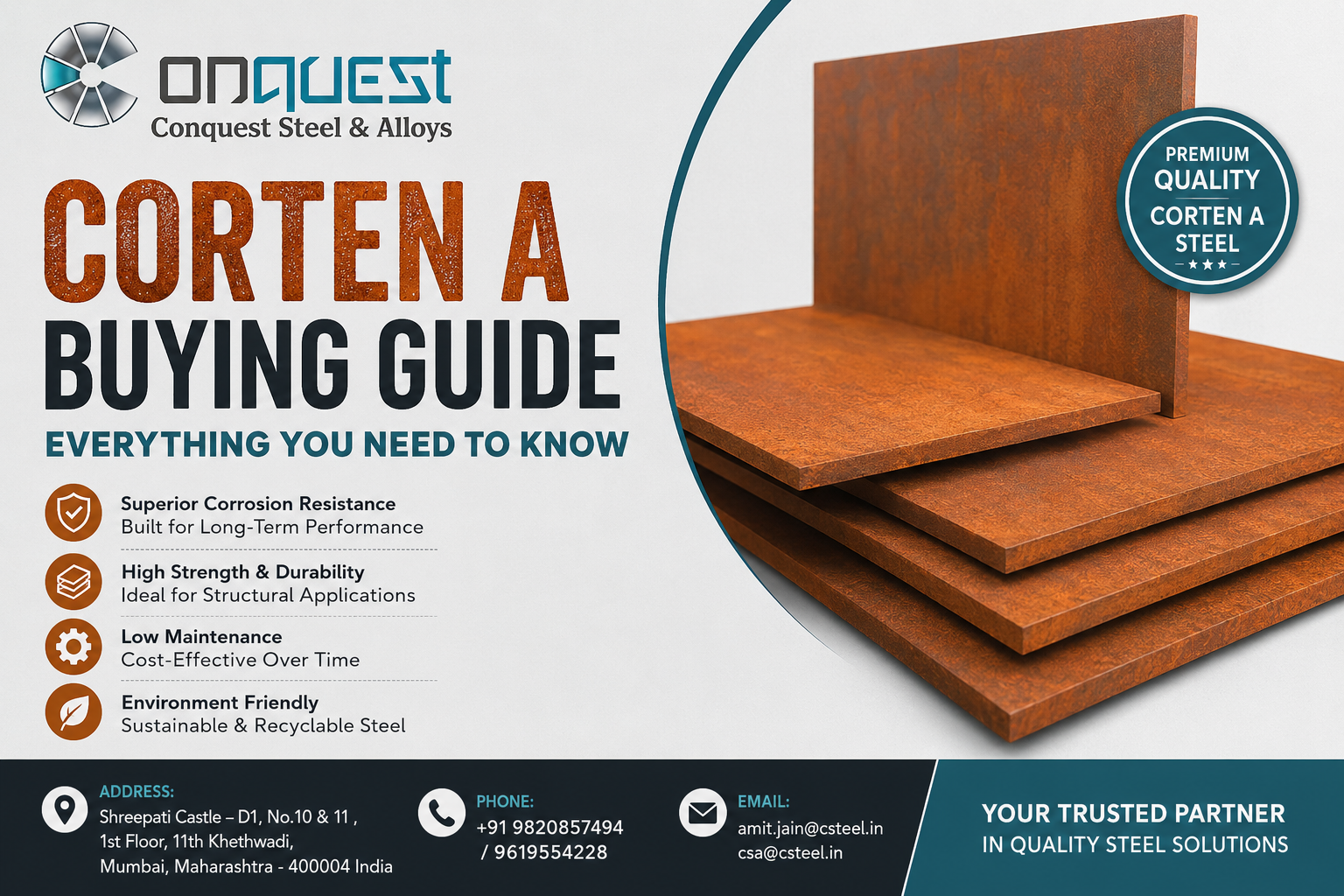
Corten A Steel — Properties, Composition, Uses, Benefits & Complete Guide
- Conquest Steel & Alloys Team
Corten A Buying Guide: Everything You Need to Know - Conquest Steel & Alloys
Conquest Steel & Alloys supplies Corten A Steel Plate, a low-alloy weathering steel engineered for superior atmospheric corrosion resistance compared to ordinary structural steel. Based in Mumbai, the company stocks and distributes this Corten A Material across standards including ASTM A242 Type 1, ASTM A606 Type 1, EN10025-5 S355J0WP/S355J2WP, JIS G3125 SPA-H, DIN 1.8945/1.8946, UNI FE 510 C1K1/D1K1, NFA 35-502 E36 WA 3/WA 4, BS 4360 WR50A, and IRSM 41-97. This Corten A Steel Sheet develops a self-healing, rust-coloured patina layer when exposed to weather, eliminating the need for regular painting while protecting the underlying structure from further oxidation. The alloy's copper, chromium, nickel, and phosphorus content gives it both its distinctive appearance and its long service life. Available in thicknesses from 0.8 mm to 50 mm, widths from 750 mm to 1,500 mm, and lengths up to 12,000 mm, these plates suit a wide range of uses — bridge girders and deck support plates, roofing and wall panels for durable housing structures, freight car bodies, fencing, and architectural cladding for facades and public installations.
With a minimum yield strength of 355 MPa and tensile strength between 470–630 MPa, Corten A Steel Grades deliver dependable structural performance alongside their corrosion-resistant properties. The Weldability of Corten A allows fabrication using spot, submerged arc, or manual welding processes, depending on plate thickness.
Conquest Steel & Alloys supplies this Corten A Weathering Steel to construction, infrastructure, and precast industries across India and exports to more than 90 countries, including the UK, Germany, USA, UAE, Saudi Arabia, and Australia, with delivery support to over 100 cities worldwide. Buyers can request mill test certificates, custom cutting, and bulk pricing directly from the Conquest Steel & Alloys team, making it a dependable Corten A Steel Supplier for projects that demand durability, certified quality, and pan-India service. Corten A Steel is one of the most trusted weathering steel grades used across construction, infrastructure, and architectural projects worldwide. If you are evaluating Corten A Steel Plate for a bridge, façade, freight car, or industrial structure, this guide covers everything you need — composition, properties, standards, applications, and buying guidance — in one place.
What is Corten A Steel Plate?
Corten A Steel Plate is a low-alloy steel that develops a stable, rust-like protective layer when exposed to the atmosphere, giving it far higher corrosion resistance than ordinary carbon steel. It is used without paint in bridges, façades, and outdoor structures that need long-term durability.
This Corten A Weathering Steel belongs to a family of alloys engineered to resist atmospheric corrosion far better than standard structural steel. The high tensile strength of these plates comes directly from their chemical make-up, which includes copper, chromium, and nickel in controlled proportions. Conquest Steel & Alloys stocks this Corten A Steel Sheet in multiple standards, including UNI FE 510 D1K1, NFA 35-502 E36 WA 4, and IRSM 41-97, to serve construction, infrastructure, and architectural clients across India and abroad.
How Corten A Steel Forms Its Protective Rust Layer
Corten A Steel Standard plates protect themselves through a self-healing oxide film called "patina," which forms naturally when the steel is exposed to alternating wet and dry weather cycles.
Here's how the process works:
- Alloying elements — copper, chromium, phosphorus, and nickel — react with oxygen and moisture in the air.
- A tightly bonded, rust-coloured oxide layer forms on the surface within the first few months of exposure.
- Unlike ordinary rust, this patina does not flake off. It adheres to the base metal and slows further oxidation.
- Over 18–36 months of natural weathering, the patina stabilises into a dense, dark brown protective shell.
- This shell keeps blocking moisture and oxygen from reaching the steel underneath, which is why these plates rarely need repainting.
This is the defining mechanism behind every Corten A Steel application — from architectural cladding to rail wagons.
Key Features of Corten A Steel
Corten A Steel Plate stands out from mild steel because of six measurable properties that directly affect its performance in the field.
- Corrosion Resistance — Copper, nickel, and higher phosphorus content bond the oxidised layer to the base steel, slowing the corrosion rate compared to regular steel plates.
- Weather Resistance — Grades like NFA 35-502 E36 WA 4 develop the protective patina described above, shielding the structure from acute atmospheric conditions.
- Paint Durability — IRSM 41-97 plates do not require painting; their orange-brown corroded coating is stable and low-maintenance.
- Weldability of Corten A — Controlled carbon content in EN10025-5 S355 J2WP plates allows spot, submerged arc, and manual welding, depending on thickness.
- Unique Aesthetic — DIN 1.8945 corrosion-resistant plates give structures a warm, oxidised finish favoured in architectural design.
- High Tensile Strength — Copper raises tensile strength when used in higher quantities, as seen in ASTM A242 Type 1 Corten steel plates.
Common Applications of Corten A Steel (Where Is Corten A Used?)
Corten A Steel is specified wherever long-term outdoor durability matters more than a painted finish.
- Bridges — main girders, cross-beams, and deck support plates that must withstand decades of weather exposure.
- Housing and industrial structures — EN10025-5 S355 JOWP plates are used for roof and wall panels that need a rustic, low-maintenance look.
- Freight cars and fencing — DIN 1.8946 weathering-resistant plates resist acidic atmospheric attack and offer a long service life.
- Construction structures — BS 4360 WR 50A plates support light, lean, sturdy designs that corrode at a slower rate.
- Architectural cladding and facades — the natural patina finish is widely specified for museums, pavilions, and public art installations.
- Shipping and transport equipment exposed to open weather for long durations.
Advantages of Corten A Steel
Choosing Corten A Steel over conventional steel delivers measurable, long-term value:
- Reduced lifecycle cost — no repainting cycle means lower maintenance spend over decades.
- Stronger structural performance — high tensile strength supports lighter, more efficient designs.
- Faster project turnaround — no primer or top-coat application required before or after installation.
- Environmentally lower footprint — fewer repaint cycles mean fewer solvents and coatings used over the structure's life.
- Distinctive appearance — favoured in modern architecture for its warm, natural, industrial finish.
Corten A Grades and Equivalents
Corten A Steel Grades are recognised under multiple international standards, which makes sourcing and specification easier across global projects.
| Standard | Equivalent Designation |
|---|---|
| ASTM | A242 Type 1 / A606 Type 1 |
| EN 10025-5 | S355J0WP / S355J2WP |
| JIS G 3125 | SPA-H |
| DIN | 1.8945 / 1.8946 |
| UNI | FE 510 D1K1 / FE 510 C1K1 |
| NFA 35-502 | E36 WA 3 / E36 WA 4 |
| BS | 4360 WR50A |
| Indian Railway Standard | IRSM 41-97 |
Conquest Steel & Alloys stocks and distributes all of the above Corten A Steel Standard equivalents, allowing project teams to match specifications without cross-border sourcing delays.
Corten A Steel Plate Sizes, Thickness & Specifications
Buyers can source Corten A Steel Plate across a wide dimensional range to suit both structural and architectural requirements.
| Specification | Range |
|---|---|
| Thickness | 0.8 mm – 50 mm |
| Width | 750 mm – 1,500 mm |
| Length | Up to 12,000 mm |
| Form | Plates and sheets |
| Finish | Hot-rolled, mill finish |
Custom cutting and sheet sizing are available on request through Conquest Steel & Alloys.
Chemical Composition of Corten A Steel
Corten A Chemical Composition includes controlled percentages of copper, chromium, and nickel that give the plate its self-protecting rust layer.
| Grade | C% | Si% | Mn% | P% | S% | Cr% | Cu% | V% | Ni% |
|---|---|---|---|---|---|---|---|---|---|
| CORTEN A | 0.12 | 0.25–0.75 | 0.20–0.50 | 0.07–0.15 | 0.030 | 0.50–1.25 | 0.25–0.55 | — | 0.65 |
The relatively high phosphorus and copper content, compared to mild steel, is what accelerates formation of the protective patina layer described earlier in this guide.
Mechanical Properties of Corten A Steel
Corten A Mechanical Properties balance strength and toughness, making it suitable for load-bearing structural applications such as bridge girders and deck plates.
| Grade | Minimum Yield Point (ReH, MPa) | Tensile Strength (Rm, MPa) | Minimum Elongation (A%) |
|---|---|---|---|
| CORTEN A | 355 | 470–630 | 20 |
- Yield Strength of Corten A: 355 MPa minimum, suitable for structural load-bearing use.
- Tensile Strength of Corten A: ranges from 470 to 630 MPa depending on plate thickness.
- Hardness of Corten A Steel: remains stable across service temperatures, supporting good impact resistance at low temperatures.
- Corten A Density: approximately 7.85 g/cm³, in line with standard structural steel.
Corten A Steel Welding Guidelines & Safety Tips
Weldability of Corten A is good when the correct process and consumables are used, thanks to its controlled carbon content.
- Use low-hydrogen electrodes matched to the base metal's copper-chromium-nickel chemistry.
- Preheat thicker sections (above 25 mm) to reduce the risk of cracking in the heat-affected zone.
- Spot welding, submerged arc welding, and manual arc welding are all suitable, depending on plate thickness.
- Avoid excessive interpass temperatures, which can weaken the corrosion-resistant properties near the weld.
- Ensure adequate ventilation — welding fumes from alloyed steel should be extracted, not just diluted.
- Post-weld, allow the weld zone to weather naturally; it will develop patina at a similar rate to the surrounding plate.
Corten A Steel Manufacturing Process
Corten A Steel Plate manufacturing follows a controlled metallurgical route to lock in its corrosion-resistant chemistry.
- Alloying — Copper, chromium, nickel, and phosphorus are added to molten steel in precise proportions.
- Casting and rolling — The alloyed steel is cast into slabs and hot-rolled into plates or sheets to the required thickness.
- Cooling and normalising — Controlled cooling develops the required mechanical properties, including yield and tensile strength.
- Cutting to size — Plates are cut to standard or custom widths and lengths as per project specification.
- Quality testing — Chemical composition, mechanical properties, and surface finish are verified before dispatch.
Corten A vs Mild Steel: Why Choose Weathering Steel?
Durability of Corten A Steel outperforms mild steel significantly in outdoor and exposed environments.
| Parameter | Corten A Steel | Mild Steel |
|---|---|---|
| Corrosion Resistance | Self-protecting patina layer | Requires paint/coating |
| Maintenance | Minimal, no repainting | Regular repainting needed |
| Tensile Strength | 470–630 MPa | Typically lower |
| Lifecycle Cost | Lower over time | Higher due to recoating |
| Appearance | Natural rust-toned finish | Requires surface treatment |
| Best Use Case | Outdoor, exposed structures | Indoor or coated applications |
For any structure exposed to open weather for years without a repainting schedule, Corten A Steel is the more economical long-term choice.
Corten A vs Corten B: Which Weathering Steel Is Better? Where Both Used
Corten A Steel and Corten B are both weathering steels, but they differ in alloy composition and typical application.
- Corten A contains higher phosphorus content, which speeds up early patina formation. It is favoured for architectural applications — cladding, sculptures, and facades — where visual finish and faster weathering matter.
- Corten B has lower phosphorus but higher manganese, giving it better weldability and more consistent mechanical performance for heavy structural use — bridges, rail wagons, and industrial frames.
- Neither grade is universally "better" — the choice depends on whether the priority is architectural finish (Corten A) or structural fabrication at scale (Corten B).
Maintenance & Care of Corten A Steel
Corten A Steel needs far less maintenance than painted steel, but a few practices extend its service life further.
- Allow the initial patina to form undisturbed for the first 12–24 months; avoid coatings during this period.
- Ensure proper drainage design — standing water on horizontal surfaces can cause uneven weathering.
- Keep the plate free of debris, leaves, or organic matter that trap moisture against the surface.
- In coastal or high-chloride environments, inspect periodically, as salt exposure can accelerate corrosion beyond the patina's protective capacity.
- Avoid contact with dissimilar metals (like aluminium or zinc) without proper isolation, to prevent galvanic corrosion.
Common Myths About Corten Steel (Debunked)
- "Corten steel never rusts." False — it rusts intentionally, forming a stable patina that then slows further corrosion.
- "It's rustproof, so it needs zero maintenance." False — drainage design and periodic inspection are still required, especially near coasts.
- "Runoff from Corten steel stains everything permanently." Partially false — early-stage runoff can stain adjacent porous surfaces, but this reduces sharply once the patina stabilises; detailing can prevent it entirely.
- "All weathering steels are the same." False — Corten A and Corten B, along with ASTM, EN, and JIS equivalents, have distinct chemical compositions suited to different use cases.
- "It can't be welded." False — with correct electrodes and preheat practices, Corten A Steel Plate welds reliably.
Certifications & Quality Standards Check Corten A
Before buying, confirm the plate is certified to the exact standard your project specifies.
- Mill test certificates confirming chemical composition and mechanical properties.
- Compliance with the relevant international standard — ASTM A242, EN10025-5, JIS G3125, DIN 1.8945/1.8946, or IRSM 41-97, depending on the project.
- Traceability of the batch/heat number back to the manufacturing mill.
- Dimensional tolerance verification for thickness, width, and length.
Questions to Ask Before Buying Corten A Steel
- What standard and grade does the plate conform to (ASTM, EN, JIS, or IRSM)?
- Can the supplier provide mill test certificates for chemical and mechanical properties?
- What thickness, width, and length ranges are available in stock?
- Does the supplier offer custom cutting or sheet sizing?
- What is the delivery timeline for the required quantity?
- Is after-sales technical support available for welding or fabrication queries?
How to Choose the Right Corten A Steel Plate (Before Buying)
Selecting the correct Corten A Steel Plate depends on matching the grade and dimensions to your project's structural and environmental needs.
- Identify the application — structural (bridges, framing) or architectural (cladding, facades) use cases call for different priorities.
- Match the standard — confirm whether your project specification calls for ASTM, EN10025-5, JIS, DIN, or IRSM grades.
- Check thickness requirements — structural load-bearing use typically needs thicker plates than decorative cladding.
- Verify environmental exposure — coastal, industrial, or high-humidity sites may need additional inspection planning.
- Confirm supplier credentials — request mill certificates, export experience, and stock availability before finalising an order.
Frequently Asked Questions (FAQs)
What is Corten A Steel?
Corten A Steel is a low-alloy weathering steel that develops a self-protecting rust-like patina when exposed to the atmosphere, reducing the need for painting.
How does Corten A Steel work?
It works by forming a tightly bonded oxide layer on its surface through natural weathering, which slows down further corrosion of the base metal.
What is the difference between Corten A and Corten B?
Corten A has higher phosphorus content and suits architectural applications, while Corten B has better weldability and is preferred for heavy structural fabrication.
Is Corten A Steel rustproof?
No, it is not rustproof. It rusts in a controlled way to form a stable protective layer, unlike ordinary steel, which corrodes continuously.
Does Corten A Steel need painting?
No. Its patina layer eliminates the need for regular painting in most outdoor applications.
How long does Corten A Steel last?
With proper design and drainage, Corten A structures commonly perform well for several decades with minimal maintenance.
Can Corten A Steel be welded?
Yes. It can be welded using spot, submerged arc, or manual arc welding, with appropriate electrodes and preheat for thicker sections.
Is Corten A Steel suitable for coastal areas?
It can be used in coastal areas, but higher chloride exposure requires closer inspection, as salt can accelerate corrosion beyond what the patina protects against.
Why Choose Conquest Steel & Alloys for Corten A Steel? – Where We Supply
Conquest Steel & Alloys is a Corten A Steel Manufacturer-aligned stockist and supplier based in Mumbai, India, serving construction, infrastructure, and industrial clients with reliable, certified material.
- Experience — Years of serving the construction, infrastructure, and precast industries with weathering steel plates and sheets.
- Expertise — Precise stock across ASTM A242, EN10025-5, JIS G3125, DIN, UNI, NFA, BS, and IRSM standards.
- Wide inventory — Thickness from 0.8 mm to 50 mm, width up to 1,500 mm, and length up to 12,000 mm, ready for dispatch.
- Export reach — Supplying Corten A Steel Plate to over 90 countries, including the UK, USA, Germany, UAE, Saudi Arabia, Singapore, and Australia.
- Pan-India service — Delivering to Mumbai, Delhi, Chennai, Bengaluru, Pune, Ahmedabad, Kolkata, Hyderabad, and 50+ other cities.
As a leading Corten A Steel plate supplier in India, Conquest Steel & Alloys positions itself among the Best Corten A Steel manufacturer in India networks for buyers seeking certified material with transparent pricing and pan-India logistics support. Conquest Steel & Alloys, based in Mumbai, is a Corten A Steel Supplier and stockist supplying this Corten A Material to over 90 countries and 100+ industrial cities.
Contact Conquest Steel & Alloys for Corten A Steel At Best Price
Corten A Steel remains one of the most reliable material choices for projects that need long-term durability without the ongoing cost of repainting. Its self-forming patina layer, high tensile strength, and good weldability make it a practical fit for bridges, industrial structures, freight equipment, fencing, and architectural cladding alike. Understanding its chemical composition, mechanical properties, and the differences between Corten A and Corten B helps project teams specify the right grade for their environment — whether that's a coastal installation, a heavy structural application, or a decorative facade.
Choosing the right supplier matters just as much as choosing the right grade. Certified mill test reports, accurate dimensional tolerances, and consistent stock availability across ASTM, EN, JIS, DIN, and IRSM standards all directly affect project timelines and structural performance. Conquest Steel & Alloys, based in Mumbai, brings all of this together — a wide inventory of Corten A Steel Plate in multiple standards and sizes, export experience across 90+ countries, and pan-India delivery to more than 100 cities.
Whether the requirement is a single test batch or a bulk structural order, working with an established Corten A Steel Supplier reduces sourcing risk and keeps fabrication schedules on track.
Ready to source Corten A Steel Plates for your project? Contact Conquest Steel & Alloys today to request a quote, ask for mill test certificates, or discuss bulk order pricing and delivery timelines with the technical sales team.


