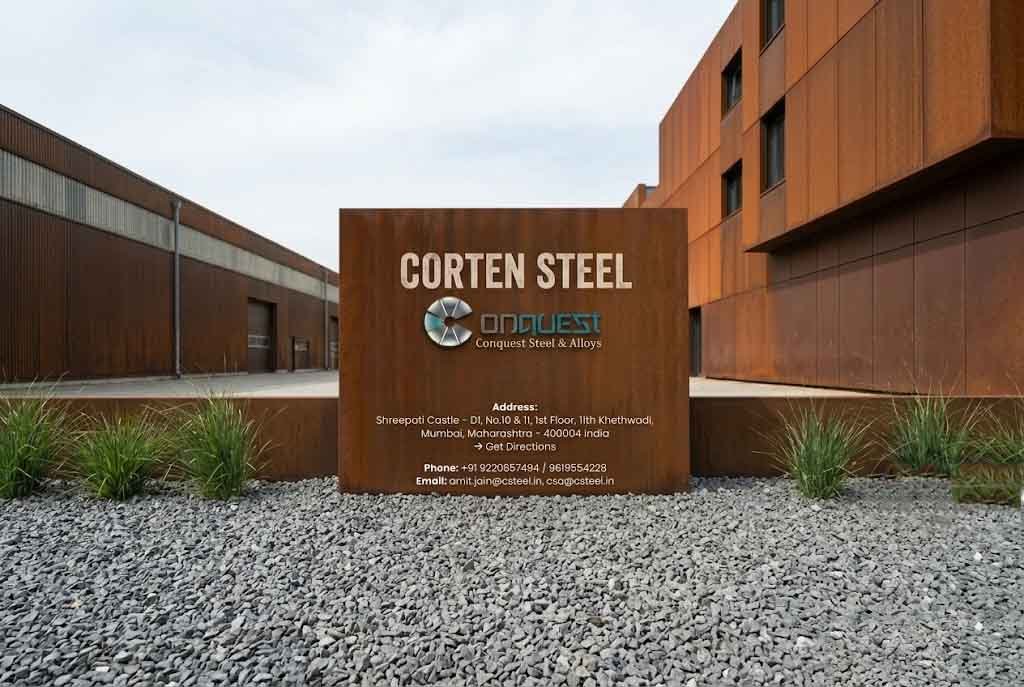
A To Z About Corten Steel - Full Guide Explained By Conquest Steel & Alloys
- Mr Bisht
That single distinction is what makes weathering steel one of the most intelligent structural materials available to architects, engineers, and designers. By engineering the chemical composition of the steel alloy to produce a dense, self-sealing oxide layer, Corten steel turns what would be a failure mode in ordinary steel into a protective mechanism. The rust becomes the armour.
This guide covers everything you need to know before specifying, purchasing, or designing with Corten steel: its chemistry, its grades, how the patina forms and what it looks like over time, where it works and where it definitively does not, and what it costs — both upfront and over a full project lifetime.
What Is Corten Steel?
Corten steel — formally known as weathering steel — is a family of steel alloys formulated to develop a stable, tightly adhering rust-like surface layer when exposed to outdoor weather. This surface layer, called a patina, acts as a barrier against further corrosion, dramatically extending the material's lifespan without the need for paint, coatings, or ongoing surface maintenance.
The name 'Corten' is a portmanteau: CORrosion resistance + TENsile strength. It was originally developed and trademarked by the United States Steel Corporation in the 1930s and first used commercially for railway coal wagons. Today the term is used generically across the industry for all weathering steel grades.
Standard steel rusts continuously until structural failure because its rust layer is porous and non-adherent. In Corten steel, the carefully chosen alloying elements alter the microstructure of the oxide layer so that it becomes dense, chemically bonded to the surface, and self-limiting. The oxidation process terminates itself.
A Brief History: The Origin Of Corten Steel
Understanding where Corten came from helps explain why it is designed the way it is.
- 1930s: U.S. Steel develops and patents the alloy for railway coal wagons needing heavy outdoor exposure without maintenance coatings.
- 1964: Eero Saarinen uses it for the John Deere World Headquarters in Moline, Illinois — the first major architectural application. The building stands today essentially uncoated.
- 1960s–1970s: Sculptors Richard Serra, Eduardo Chillida, and Isamu Noguchi adopt the material for large outdoor works, attracted by its textural richness.
- 1970s–1990s: Widespread use in highway bridge construction across the US, UK, and Germany, driven by lifecycle cost advantages.
- 1998: Antony Gormley's Angel of the North is installed in Gateshead, UK. At 20 metres tall with a 54-metre wingspan, it becomes the most publicly visible Corten steel structure in the world.
- 2005: Herzog & de Meuron complete the de Young Museum in San Francisco with a Corten steel facade, cementing the material's status in contemporary architecture.
Chemical Composition: What's In It and Why It Matters
Corten steel's distinctive performance comes from carefully controlled additions of specific alloying elements to the base iron-carbon steel. Each element plays a distinct role:
- Copper (Cu) — typically 0.25–0.55% - The single most important element for weathering performance. Copper accelerates formation of the protective patina and is the primary reason Corten's oxide layer is denser and more adherent than that of ordinary steel.
- Chromium (Cr) — typically 0.5–1.25% - Enhances corrosion resistance and stabilises the oxide layer's chemistry. Chromium serves the same role in stainless steel — it promotes stable, protective oxidation rather than destructive rusting.
- Nickel (Ni) — up to 0.65% - Improves toughness and contributes to both corrosion resistance and overall strength.
- Phosphorus (P) — up to 0.15% - A critical but double-edged element. Phosphorus significantly improves corrosion resistance but must be carefully controlled — excess phosphorus causes brittleness in welded joints. This is why Corten A (higher phosphorus) is not suitable for structural welded connections.
- Silicon (Si) — typically 0.25–0.75% - Acts as a deoxidiser during steel-making and contributes to strength.
- Manganese (Mn) — typically 0.20–0.50% - Improves hardness, strength, and wear resistance. Higher in Corten B to compensate for reduced phosphorus content while maintaining corrosion resistance.
Together, these elements produce a patina composed primarily of goethite (α-FeOOH) and related iron oxyhydroxides — chemically distinct from the loose, porous iron oxide (Fe₂O₃) that forms on ordinary steel. That distinction is everything.
Grades and Standards: Which One Do You Need?
Weathering steel is not a single material. Selecting the wrong grade is one of the most common and costly specification errors.
| Grade | Standard | Application | Key Characteristic |
|---|---|---|---|
| Corten A | ASTM A242 | Cladding, facades, decorative (non-structural) | Higher phosphorus — NOT for structural welded connections |
| Corten B | ASTM A588 | Structural beams, bridges, frames, load-bearing | Lower phosphorus, higher Mn — fully weldable |
| S355J0WP | EN 10025-5 | Cladding/decorative (European equivalent to A) | Higher phosphorus variant — non-structural only |
| S355J2W | EN 10025-5 | Structural (European equivalent to B) | Sub-zero toughness tested — weldable structural grade |
Structural and welded: use Corten B / ASTM A588 / EN S355J2W. Cladding, screening, or decorative: use Corten A / ASTM A242 / EN S355J0WP. When in doubt, specify Corten B. Always confirm with a qualified structural engineer for any load-bearing application.
How the Patina Forms: The Science in Four Steps
- First exposure — Iron oxide begins to form as Corten steel contacts rain and atmospheric oxygen, just as it does on any steel. At this stage, the surface looks like any other newly rusting metal.
- Wet-dry cycling begins — As the steel goes through repeated wetting and drying cycles, the alloying elements — particularly copper, chromium, and phosphorus — begin migrating into the oxide layer, displacing and altering its crystal structure.
- Patina densification — The altered chemistry produces a compound oxide that has fewer microscopic pores, bonds chemically and mechanically to the steel surface, and progressively restricts the diffusion of oxygen and moisture to the metal below.
- Stabilisation — As the patina thickens and densifies, the corrosion rate decelerates and eventually approaches near-zero. The patina has become self-sealing.
Wet-dry cycling is non-negotiable. Without the steel regularly getting wet and then fully drying out, the alloying elements cannot migrate into and transform the oxide layer. This is why Corten fails in permanently wet and marine environments.
What the Patina Looks Like: A Visual Timeline
This is consistently one of the most searched questions about Corten steel — and for good reason. The early stages frequently alarm clients who weren't prepared for them.
| Time Period | Patina Development Stage |
|---|---|
| Days 1–30 | Patchy early orange rust appears after first rainfall. Surface looks like damp, rusted mild steel. Colour is variable and uneven. This is completely normal. |
| Months 1–6 | Orange-red rust develops across the full surface — sometimes alarmingly bright in wet weather. Run-off staining is at its most active. This stage often surprises clients. |
| Months 6–18 | Rust deepens in colour. Rich reds, warm oranges, and early dark tones appear in sheltered areas. Surface texture begins to develop genuine character. |
| Years 2–5 | Patina stabilises into deep warm brown — often described as mahogany or dark chocolate. Run-off staining reduces dramatically. This is the intended final appearance. |
| Years 5+ | Patina continues to mature. Complex granular texture with tonal variation. Unlike painted surfaces, fully developed Corten becomes more visually compelling with age. |
The gap between the 'months 1–6' and 'years 2–5' stages is the single most common source of client dissatisfaction with Corten projects. Anyone approving a Corten installation must be shown reference photographs of both the early and mature stages before the project proceeds.
Benefits of corten steel
Corten Steel, also known as weathering steel, is a specially designed steel that forms a stable rust-like surface called a protective patina, which shields the metal from further corrosion. One of its biggest benefits is natural corten corrosion resistance, as the patina layer develops when the steel is exposed to air and moisture, preventing deeper rust and eliminating the need for paint or protective coatings. This feature leads to very low maintenance, since there is no requirement for regular repainting or anti-corrosion treatments, significantly reducing long-term maintenance costs. Corten steel is also known for its long lifespan, often lasting 40 to 80 years or more in suitable environments while performing well under rain, snow, and changing temperatures. Another major advantage is its unique aesthetic appearance, as the natural orange-brown rusted finish creates a modern, industrial look that is widely used in architecture, landscaping, outdoor sculptures, and building facades. In addition, it offers high structural strength, making it suitable for heavy-duty applications such as bridges, structural frameworks, and large outdoor installations. From an environmental perspective, Corten steel is eco-friendly because it requires no chemical coatings and is fully recyclable, reducing material usage over time. Although its initial cost can be slightly higher than regular steel, the savings from minimal maintenance, no painting, and long service life make it a cost-effective material over the long term.
Common Uses of Corten Steel
- Architectural cladding
- Bridges and infrastructure
- Outdoor sculptures
- Garden planters and landscaping elements
- Industrial buildings
✅ Example: The famous sculpture Angel of the North in the UK is made from Corten steel.
Why is Corten Steel So Popular?
Corten Steel has become highly popular in architecture, landscaping, and infrastructure because it combines durability, low maintenance, structural strength, and a distinctive appearance. One of the main reasons for its popularity is its natural rust-like patina, which develops a warm orange-brown surface that changes over time, giving buildings a modern, industrial, and artistic look that architects often use to create striking designs. Unlike ordinary steel, Corten forms a stable protective rust layer when exposed to weather, which slows further corrosion and removes the need for paint or protective coatings, making it ideal for outdoor structures. This protective layer also means very low maintenance, as there is no need for frequent repainting or corrosion treatments, significantly reducing long-term costs. Additionally, Corten steel offers a long lifespan, performing well for decades in environments with rain, snow, temperature changes, and urban conditions. From a sustainability perspective, it requires fewer chemical coatings, is fully recyclable, and has a long service life, making it suitable for environmentally conscious construction. Combined with high structural strength similar to other structural steels, it is widely used in bridges, building facades, landscaping elements, and large infrastructure projects, which explains why it has become a preferred material in many iconic architectural designs. Its popularity increased because many famous structures use it, such as the sculpture Angel of the North, which showcases the material’s dramatic weathered appearance. Corten steel is popular because it looks unique, lasts a long time, needs little maintenance, and performs well outdoors.
Climate and Environment: Where Corten Works and Where It Fails
This is the most consequential section of this guide. Environmental suitability must be assessed for every individual project. Specifying Corten in an unsuitable environment has resulted in some of the most expensive material failures in modern architectural practice.
Suitable Environments - Temperate climates with distinct wet and dry seasons provide the wet-dry cycling needed for stable, reliable patina development. Most of Northern and Central Europe, much of North America (excluding coastal zones), New Zealand, and parts of southern Australia are well-suited. These are the environments Corten was engineered for.
Unsuitable Environments
Marine and Coastal — The Most Critical Exclusion
Salt-laden air is Corten's principal enemy. Chloride ions from sea spray chemically interfere with the protective patina, preventing it from stabilising. In marine conditions, Corten steel can corrode at rates exceeding those of ordinary painted steel — the precise opposite of its intended performance.
| Guidance Type | Recommendation |
|---|---|
| Conservative Guidance | Avoid Corten within 300–500 metres of the sea |
| Cautious Guidance (Recommended) | 1–2 km exclusion zone, adjusted for prevailing wind direction and local salt levels |
- Permanently Wet Conditions - Any situation where the steel cannot fully dry out — permanent contact with standing water, enclosed spaces with persistent condensation, or ground burial — prevents patina stabilisation and allows corrosion to continue at an elevated rate.
- Heavily Polluted Industrial Environments - High concentrations of sulphur dioxide (SO₂) near power stations or industrial plants interfere with patina chemistry and accelerate corrosion. C4 and C5 corrosivity category environments (per ISO 9223) are generally unsuitable.
- Very Arid and Tropical/Humid Climates - Very arid environments produce a dusty, reddish surface rather than a stable deep brown — not a structural failure, but the intended aesthetic will not develop. Continuous high humidity without drying cycles presents issues similar to permanent wetting.
Mechanical Properties
| Property | Corten B / S355J2W | Significance |
|---|---|---|
| Yield Strength | ~355 MPa | Significantly stronger than S275 (~275 MPa) — allows thinner sections |
| Tensile Strength | 470–630 MPa | High-strength range suitable for demanding structural applications |
| Elongation | ~20–22% | Confirms adequate ductility — material deforms before fracturing |
| Hardness | ~155–170 BHN | Slightly harder than mild steel; good wear resistance |
Fabrication: Cutting, Forming, Welding
Cutting - All standard methods work: plasma cutting, laser cutting, oxy-fuel cutting, mechanical sawing, and shearing. Plasma and laser cutting are most common for both structural and decorative work. Cut edges will rust and integrate naturally into the overall patina over time.
Forming - Cold-forming (bending, rolling) works comparably to mild steel, but the higher yield strength requires appropriately rated equipment. Minimum bend radii are somewhat larger than for equivalent mild steel — consult the supplier's technical data sheet for grade-specific limits.
Welding — Critical Notes
Corten B is readily weldable using MIG (GMAW), TIG (GTAW), MMA (SMAW), and submerged arc welding.
CRITICAL - Filler metal selection is the single most important fabrication decision. Dedicated weathering steel welding consumables must be used — not standard mild steel fillers. Using mild steel fillers produces welds that rust and age inconsistently with the parent metal: visually unacceptable in architectural work, and a potential structural weak point. Preheating requirements apply for thicker sections. Follow EN 1011-2 in Europe or AWS D1.1 in North America for preheat temperature based on section thickness and carbon equivalent value.
Bolted Connections
Weathering steel structural bolts are mandatory for exposed connections: ASTM A325 Type 3 or A490 Type 3 in North America; equivalent EN weathering bolt grades in Europe. Standard galvanised bolts cause galvanic corrosion at the contact point. Stainless steel fasteners can also create galvanic coupling and should be isolated if used.
Rust Run-Off and Staining: The Most Overlooked Design Issue
Rust run-off is the most consistently underestimated practical problem in Corten specification. During the active patination period — and at lower rates indefinitely — rainfall washes iron oxide particles off the surface, creating orange-brown staining on adjacent concrete, stone, paving, rendered walls, and timber.
IMPORTANT - This is not a defect. It is an unavoidable inherent property of the material that must be explicitly designed around.
Design Strategies for Managing Run-Off
- Orientation: Design drainage to direct run-off away from sensitive adjacent surfaces rather than across them.
- Drip edges and copings: Projecting drip details (25–30mm) throw water clear of surfaces below.
- Dedicated channels: Drainage channels beneath Corten elements capture run-off and direct it to drainage. Keep clear of debris.
- Temporary protection: Sensitive surfaces (light paving, white render, glass) should be protected during construction and the first 12–18 months of exposure.
- Chemical remediation: Oxalic acid-based rust stain removers are most effective for established staining on porous surfaces. Multiple applications usually required.
| Cost & Maintenance Factor | Option A: Standard Painted Steel | Option B: Weathering Steel (Corten B) |
|---|---|---|
| Initial Cost | Baseline | Baseline + 25–30% premium on steelwork |
| Repaint Year 20 | ~60–80% of original coating cost | No repaint required |
| Repaint Year 40 | Similar repaint cost again | |
| Repaint Year 60 | Similar repaint cost again | |
| Total Maintenance Painting | 150–200% of original steelwork cost | Zero (in suitable environment) |
| Net Position at Year 75 | Higher lifecycle cost | Typically 20–40% cheaper than Option A |
Maintenance Schedule
In a suitable environment, with fully stabilised patina (typically 3–5 years after installation):
- Annual: Visual inspection of patina condition. Check for unusual corrosion, patina loss, or standing water. Clear drainage channels of debris.
- 5-yearly: Detailed inspection as part of a condition survey. Check bolted connections, weld areas, and any areas of historical concern.
- As needed: Address patina failures or drainage blockages promptly. Apply oil/wax treatment to interior surfaces on schedule.
- Never required (in suitable environments): Painting, blasting, recoating, or structural corrosion treatment.
For comparison, painted structural steel typically requires full repainting every 15–25 years, each cycle involving scaffold erection, blast cleaning, multi-coat paint application, and inspection. Over 75 years, that is three to five full repaint cycles.
Difference Between Corten Steel and Regular Steel
Properties
Corten steel is a weathering steel specially designed to develop a protective rust-like surface (patina) when exposed to air and moisture. This patina acts as a barrier that slows down further corrosion and protects the inner steel from damage. Because of this property, Corten steel does not require additional paint or protective coatings in most outdoor environments.
Regular steel, on the other hand, does not have this self-protective capability. When exposed to moisture and oxygen, ordinary steel rusts continuously, which can weaken the material over time. To prevent corrosion, regular steel typically requires painting, galvanizing, or protective coatings.
Combination of Elements
Corten steel contains a specific combination of alloying elements such as copper, chromium, nickel, and phosphorus along with iron and carbon. These elements help the steel develop the protective patina and improve its resistance to atmospheric corrosion. Because of this alloy composition, Corten steel also has good strength and durability.
Regular steel mainly consists of iron and carbon, sometimes with small amounts of other elements depending on the grade. While it is strong and widely used in construction and manufacturing, it lacks the specialized alloy elements that give Corten steel its weather-resistant properties.
Corrosion Resistance
One of the biggest advantages of Corten steel is its excellent corrosion resistance. When the steel is exposed to weather conditions, the outer layer rusts initially but then stabilizes into a protective coating. This layer prevents deeper corrosion and significantly extends the lifespan of the material in suitable environments.
Regular steel does not form a stable protective layer. Instead, rust continues to spread deeper into the material when exposed to moisture, humidity, or oxygen. Over time, this can weaken the structure and lead to costly repairs or replacements.
Costing
Corten steel generally has a higher initial cost compared to regular steel because of its alloy composition and specialized manufacturing process. However, it often becomes more cost-effective in the long term since it requires little to no maintenance, repainting, or corrosion protection.
Regular steel is usually cheaper at the beginning, making it a common choice for many construction projects. However, additional costs may arise over time due to painting, protective coatings, and maintenance needed to prevent corrosion.
Applications
Corten steel is commonly used in architecture, landscaping, bridges, sculptures, and building facades where both durability and aesthetic appeal are important. Its natural rusted appearance gives structures a modern, industrial, and artistic look, making it a favorite material among architects and designers.
Regular steel is one of the most widely used construction materials in the world. It is used for structural frameworks, machinery parts, automobiles, tools, infrastructure, and industrial equipment. Because of its versatility and lower initial cost, it is used in a wide range of industries including construction, automotive, aerospace, and manufacturing.
Frequently Asked Questions
Q: Does Corten steel rust through?
No. In suitable environments, the protective patina is self-limiting — it seals the surface and prevents further corrosion penetrating the metal. However, in unsuitable environments (marine, permanently wet, heavily polluted), the patina cannot stabilise and corrosion can continue, potentially compromising the material over time.
Q: How long does Corten steel take to develop its patina?
In a typical temperate climate, the patina stabilises to a deep, stable brown within 2–5 years. The early orange-red appearance emerges within weeks of first exposure. The final deep brown colour takes 2–5 years to develop fully.
Q: Can you use Corten steel near the sea?
Generally, no. Marine and coastal environments with salt-laden air prevent the protective patina from stabilising. The standard guidance is to avoid Corten within at least 300–500 metres of the sea, with a cautious exclusion zone of 1–2 km where onshore winds carry salt inland. Always obtain a site-specific corrosivity assessment for coastal locations.
Q: How much does Corten steel cost compared to ordinary steel?
The raw material carries a 20–40% premium over standard mild steel. In 2023–2024, UK pricing was approximately £950–£1,350/tonne for Corten versus £750–£950/tonne for mild steel. However, on a whole-life cost basis over 50+ years, weathering steel is typically neutral to cheaper because it eliminates repainting cycles.
Q: What is the difference between Corten A and Corten B?
Corten A (ASTM A242) is the original, higher-phosphorus grade — suitable for non-structural cladding but NOT for structural welded connections. Corten B (ASTM A588) is the structural grade — lower phosphorus, higher manganese, fully weldable, suitable for load-bearing applications such as bridges, structural frames, and columns.
Q: How do you remove rust stains from surfaces stained by Corten run-off?
Oxalic acid-based products are the most effective. Apply to the stained surface, allow to dwell 15–30 minutes, scrub with a stiff brush, and rinse thoroughly. Multiple applications are usually required for established staining. Prevention through good design detailing is far preferable to remediation.
Q: Does Corten steel need any maintenance?
In a suitable environment, essentially none beyond annual visual inspection and keeping drainage details clear. No painting, coating, or surface treatment is required once the patina has stabilised.
Q: Can Corten steel be used indoors?
Yes, but the approach differs. Indoors, the steel will not develop a stable protective patina (no wet-dry cycling), and active rust transfer to adjacent surfaces is a concern. Interior Corten applications are treated with penetrating oils or waxes to arrest the rust and seal the surface. These treatments require periodic reapplication.
Specification Checklist: 10 Things to Confirm Before Ordering
Complete every item on this checklist before proceeding with a Corten steel specification:
- Environmental suitability confirmed. - No marine conditions. No permanent wetting. Adequate wet-dry cycling expected. Corrosivity category C1–C3 (ISO 9223). If borderline, commission a corrosivity assessment
- Correct grade selected. - Corten A / ASTM A242 / EN S355J0WP for non-structural cladding. Corten B / ASTM A588 / EN S355J2W for all structural members.
- Weathering steel welding consumables specified. - Not standard mild steel fillers. Specify by grade and confirm with the fabricator before work begins.
- Weathering steel structural bolts specified. - ASTM A325 Type 3 or A490 Type 3 (North America) or equivalent EN grade (Europe) for all exposed bolted connections.
- Details checked for water traps and crevices. - Any location where water can sit and not drain is a potential patination failure point.
- Drainage designed to manage rust run-off. - Direct run-off away from all sensitive adjacent materials — light paving, rendered walls, glass, and natural stone.
- Isolation details at all dissimilar metal interfaces. - Neoprene, nylon, or bituminous isolation at every junction with copper, brass, zinc, and stainless steel.
- Patination period factored into programme. - The material will look very different at 6 months versus 4 years. This must be communicated formally before contract.
- Client formally briefed and confirmed in writing. - Reference photographs of early and mature patina should be included in the briefing document.
- Interior/hybrid applications fully specified. - Confirm oiling, waxing, or sealing product and reapplication schedule for any non-outdoor application.
Why To Choose Corten Steel
Corten Steel is often chosen for construction, architecture, and outdoor structures because it combines durability, low maintenance, and a distinctive aesthetic. When exposed to the environment, it develops a stable rust-like patina that protects the steel from further corrosion, eliminating the need for frequent painting or coatings. This natural protective layer helps reduce maintenance costs while ensuring a long service life. In addition, its warm, weathered appearance gives buildings, bridges, and sculptures a modern industrial look, making it both a practical and visually appealing material for long-term outdoor applications.
Contact Conquest Steel & Alloys For Corten Steel Plate At Best Price in India
Established in 2008, Conquest Steel & Alloys is a reputed wholesale trader, exporter, and supplier of a wide range of steel products, including corten steel, steel plates, stainless steel plates, high-strength steel plates, Corten Weathering Resistant Steel (HSLA) plates, boiler plates, and abrasion-resistant plates. The company sources its products from reliable vendors, ensuring high quality, dimensional accuracy, strong tensile strength, and excellent corrosion resistance. Strict quality testing is carried out before procurement to maintain consistent standards. With strong vendor relationships and a skilled team, the company effectively meets the diverse requirements of industries such as automotive, chemical, engineering, defence, and fertilizers. Guided by the leadership and business expertise of **Amit Jain**, the company has strengthened its presence in the global market. Supported by an efficient agent network, outsourced transportation facilities, and timely deliveries, it maintains a competitive edge. Its product range also includes corrosion-resistant and weathering steel plates like Corten plates, ASTM A588, ASTM A242, and EN 10025-5 grades.
Conclusion
Corten steel is one of a small number of structural materials that gets better — structurally and aesthetically — as it ages. Through carefully engineered chemistry, it converts what is a failure mechanism in ordinary steel into a protective one. The rust is not the problem. The rust is the point. It rewards careful specification: the right grade, the right environment, the right fabrication details, and honest communication with the client about what they will be looking at in year one versus year five. It punishes casual or uninformed use: the wrong environment, inadequate drainage design, the wrong bolts, or clients who weren't prepared for the transition. Used correctly — correctly sited, correctly fabricated, correctly detailed, and with expectations honestly set — it is one of the most durable, characterful, and genuinely low-maintenance materials available to anyone building outdoors.
Know the material. Specify it correctly. Then let time do its work.


