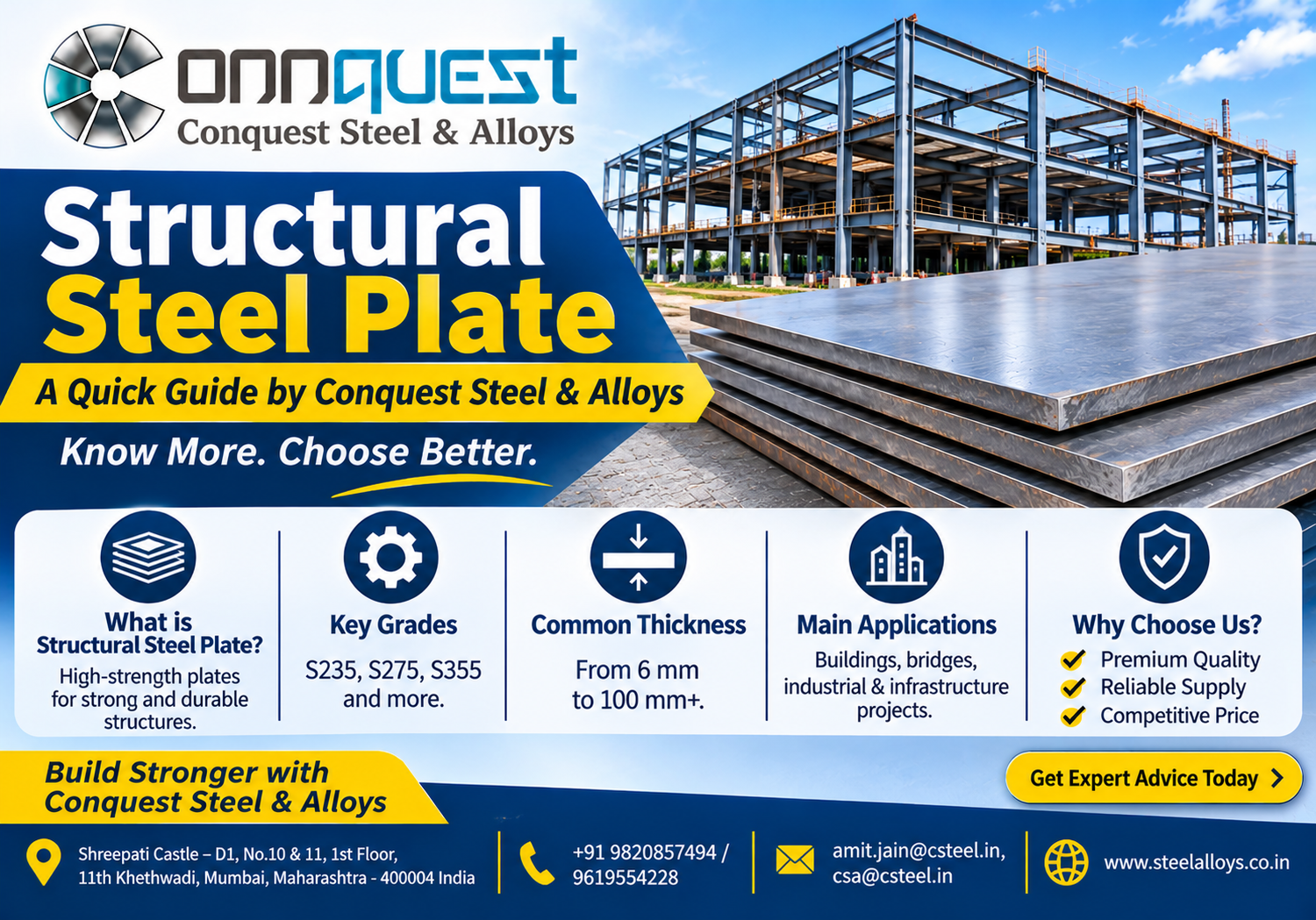
Structural Steel Plate - A Quick Guide by Conquest Steel & Alloys
- Conquest Steel & Alloys Team
S235 Structural Steel Plates Suppliers & Exporter in India - Conquest Steel and Alloys
Structural steel plate is flat-rolled carbon-manganese steel made for load-bearing use in buildings, bridges, towers, plant and heavy equipment. Its main grades are IS 2062 E250 (A, B and C) in India and EN 10025-2 S235 (JR, J0 and J2) in Europe. They give a minimum yield strength of about 235 to 250 MPa, good weldability and easy fabrication.
The letters in a grade name show toughness. JR is tested at +20°C, J0 at 0°C and J2 at −20°C. Higher-strength grades such as E300, E350 and S355 suit heavier loads. Weathering grades suit exposed structures. Structural plate differs from boiler and pressure vessel plate, which has tighter chemistry and notch toughness for pressure service. It also differs from high tensile plate, which gives a higher yield strength at lower weight.
Conquest Steel & Alloys is a leading structural steel plate supplier, stockist and exporter in India, with more than 30 years of experience. We stock IS 2062 E250 A, B and C, SAILMA 250 and 250HI, S235JR, S235J0 and S235J2 plates from 5 mm to 200 mm thick and up to 3.5 m wide. Plates are supplied with mill test certificates and quality records, cut to size by plasma or oxy-fuel cutting, and packed securely for domestic and export delivery. We serve construction, infrastructure, power, oil and gas, railway and heavy engineering buyers in India and in more than 100 countries. Prices depend on grade, thickness, size and quantity. Send us your requirement and we will reply with a quote.
What Is Structural Steel Plate?
Structural steel plate is flat-rolled carbon-manganese steel made to carry loads in buildings, bridges, towers, plant and heavy equipment. Common grades are IS 2062 E250 and EN S235JR, J0 and J2. These offer a minimum yield strength of about 235 to 250 MPa, good weldability and easy cutting.
Conquest Steel & Alloys - Top Structural Steel Plate Stockist, Supplier and Exporter in India For More Than 30+Years
Conquest Steel & Alloys is a Mumbai-based structural steel plate supplier, stockist and exporter. We have more than 30 years of experience in steel sourcing, stocking and supply chain. We buy from mills that follow international plate standards. Our stock covers IS 2062 E250 A, B and C, SAILMA 250 and 250HI, and S235JR, S235J0 and S235J2 plates. We supply fabricators, EPC contractors, infrastructure builders and engineering firms in India and in more than 100 countries. Need a quote? Send us the grade, thickness, size and quantity. We will reply with price and availability.
What Are Examples of Structural Steel?
Structural steel comes in many shapes. Each shape carries load in a different way.
- Plates: Flat sheets for base plates, gussets, girders and tanks
- Beams (I-beams and H-beams): Main horizontal supports
- Channels: C-shaped sections for frames and purlins
- Angles: L-shaped sections for bracing and trusses
- Hollow sections: Square, rectangular and round tubes
- Tees and flats: Smaller framing members
Structural steel plate is the most flexible of these. Fabricators cut, drill, weld and bolt plate into custom parts.
What Are the Different Types of Structural Steel Plates?
| Type | Typical Grades / Best For |
|---|---|
| Mild or Carbon-Manganese Structural Plate | Typical grades:- IS 2062 E250, S235JR, S235J0, S235J2 -Best for:- General buildings, frames, supports |
| Higher-Strength Structural Plate | -Typical grades:- IS 2062 E300, E350, EN S275, S355 -Best for:- Heavier loads, bridges, thinner sections |
| Weathering Structural Plate | -Typical grades:- S235J0W, S235J2W, Corten grades -Best for:- Exposed outdoor structures with low upkeep |
| Cold-Formed Grades | -Typical grades:- Grades suitable for cold forming -Best for:- Parts bent without cracking |
| Impact-Tested Plate | -Typical grades:- J0, J2, E250 B and C -Best for:- Cold climates, dynamic loads |
The grade letters tell you about toughness. JR is tested at room temperature (+20°C). J0 is tested at 0°C. J2 is tested at −20°C.
What Type of Steel Is Used for Structural Steel?
Most structural steel is low-carbon, carbon-manganese steel. It has carbon below about 0.25%, with manganese for strength. It is chosen because it is strong enough, weldable, easy to fabricate and cost-effective.
Common grades:
- India: IS 2062 E250 (A, B, C), E300, E350
- Europe: EN 10025-2 S235, S275, S355
- USA: ASTM A36, A572, A283
Typical alloying elements are carbon and manganese. In higher-strength grades, small amounts of niobium or vanadium are added.
What Is the Difference Between Steel and Structural Steel?
"Steel" is the broad family. "Structural steel" is the group made to a standard for building and load-bearing use. Structural steel is controlled for yield strength, tensile strength, weldability and toughness. Plain steel sold with no grade may not meet any of these.
Practical point: Always buy by grade and standard (for example IS 2062 E250 B), with a mill test certificate. Do not buy by the name "mild steel" alone.
Structural vs Boiler vs High Tensile Plates: What Is the Difference?
| Comparison Factor | Structural Plate | Boiler / Pressure Vessel Plate | High Tensile Plate |
|---|---|---|---|
| Main Purpose | Carrying load in structures | Holding pressure and heat | High strength at lower weight |
| Example Grades | E250, S235JR | ASTM A515, A516, A204 | E350, S355, Q&T grades |
| Tests Required | Yield, tensile, bend; impact in some grades | Stricter chemistry, notch toughness, often normalised | Higher yield and tensile strength |
| Typical Use | Buildings, bridges, towers | Boilers, tanks, pressure vessels | Cranes, bridges, heavy machinery |
| Cost | Lowest | Higher | Medium to high |
Rule of thumb: Do not use plain structural plate for a pressure vessel. Use a pressure-vessel grade as specified by your code.
What Are Structural Steel Plates Used For?
- Buildings: Base plates, gussets, stiffeners, floor and roof framing
- Bridges and flyovers: Girders and connection plates
- Industrial sheds and factories: Frames, columns and platforms
- Towers and masts: Transmission, telecom and tall structures
- Stadiums, malls and commercial complexes: Large-span structures
- Railways and metros: Coaches, platforms and terminals
- Machinery and equipment: Frames, bases and chassis
- Storage tanks and silos: Non-pressure shells and structures
Features of Structural Steel Plate
- Strong and tough: Carbon and manganese give a good balance of strength and ductility.
- Higher load capacity: Structural plate carries heavy loads and keeps member sizes manageable.
- Easy to fabricate: It can be cut, drilled, bent, welded and bolted with common methods.
- Fast erection: Plates arrive cut to size and can be assembled on site quickly.
- Repairable: Damaged members can be cut out and re-welded.
- Recyclable: Steel can be recycled many times.
Common Grades and Standards
| Standard | Common Grades |
|---|---|
| IS 2062 (India) | E250 A, B, C; E300; E350 |
| EN 10025-2 (Europe) | S235JR, S235J0, S235J2; S275; S355 |
| ASTM (USA) | A36, A283 Gr C |
| SAIL Brands | SAILMA 250, SAILMA 250HI, SAILMA 300, SAILMA 300HI |
| IS 226 | Older Indian standard, now replaced by IS 2062 |
Structural Steel Plates: Grades and Specification
Our range:
- Thickness: 5 mm to 200 mm
- Width: Up to 3.5 metres
- Length: Per mill sizes and your cutting list (ask us)
- Grades: JR, J0, J2 and IS 2062 E250 A, B and C
- Cutting: Plasma and oxy-fuel cutting to size
- Supply condition: As-rolled or normalised, depending on grade
Equivalent Grades of S235JR, S235J0 and S235J2
These grades are close, not always identical. Confirm chemistry and testing against your project standard.
| EN Grade | Indian Equivalent / Other Close Grades |
|---|---|
| S235JR (EN 10025-2) | Indian equivalent: IS 2062 E250 A, SAILMA 250, IS 226 Other close grades: DIN RSt37-2 / St37-2, JIS SS400, ASTM A283 Gr C, GB Q235B, ISO E235B, Fe360B, BS 40B |
| S235J0 | Indian equivalent: IS 2062 E250 B, SAILMA 250HI Other close grades: DIN St37-3U, GB Q235C, ISO E235C, Fe360C, BS 40C |
| S235J2 | Indian equivalent: IS 2062 E250 C, SAILMA 250HI Other close grades: DIN St37-3N, GB Q235D, ASTM A36 (close), Fe360D2, S235J2G4, BS 40EE |
Other grades on enquiry: IS 2062 E300 A / B, SAILMA 300 / 300HI, EN S275J2G4, Fe430C, Fe430D2, DIN St44-3 and AFNOR E28-3.
Structural Steel Plate Properties
| Property | S235JR / IS 2062 E250 (Typical) |
|---|---|
| Minimum Yield Strength | 235 MPa (S235, up to 16 mm) / 250 MPa (E250, up to 20 mm) |
| Tensile Strength | 360–510 MPa (S235) / 410 MPa minimum (E250) |
| Carbon Content | Low, roughly 0.17–0.23% max, depending on grade and thickness |
| Impact Testing | JR at +20°C, J0 at 0°C, J2 at −20°C |
| Weldability | Good with standard procedures |
| Elongation | About 22–26%, depending on thickness |
Yield strength drops slightly as thickness rises. Check the mill test certificate for exact values.
What the Grade Codes Mean
- S: Structural steel
- 235: Minimum yield strength in MPa
- JR / J0 / J2: Toughness level, tested at +20°C, 0°C or −20°C
- W: Weathering steel
- G / G4: Older marks for the steel's deoxidation state (not often used now)
Structural Steel Plate Application Industries
- Commercial and public buildings: Malls, stadiums, airports and offices, where AFNOR E24-2 and E250 plates carry heavy crowds and equipment
- Industrial plants and towers: Factories and skyscraper cores, where IS Fe410-S plates are strong and easy to fabricate
- Railways and metro: Coaches, terminals and platforms, where BS 40A and similar plates give formable strength
- Power and energy: Support structures, boiler frames and ducts
- Oil and gas: Platforms, skids and support frames
- Infrastructure: Bridges, flyovers, ports and transmission towers
- Heavy engineering: Cranes, earth-moving machines and fabricated equipment
Structural Steel Plate Advantages and Disadvantages
Advantages
- Strong for its weight and cost
- Easy to cut, weld and bolt
- Quick to erect on site
- Repairable and recyclable
- Widely available in standard grades
Disadvantages
- Rusts without paint, galvanising or another coating
- Loses strength in a fire, so fireproofing may be needed
- Heavy compared with some alternatives
- Needs inspection and maintenance in harsh environments
Other Types of Structural Steel Plate
- Weathering steel plate (S235J0W, S235J2W, Corten): Forms a protective rust layer and cuts painting needs
- Chequered plate: Raised pattern for anti-slip floors and walkways
- High-strength structural plate (E350, S355): Thinner sections for the same load
- Normalised plate: Heat-treated for uniform grain and better toughness
- Cold-forming grades: For parts that need tight bending
Conquest Steel & Alloys - Most Popular Structural Steel Grades We Supply
- IS 2062 E250 A / B / C: Standard Indian structural grades
- S235JR, S235J0, S235J2 (EN 10025-2): For European-standard projects
- SAILMA 250 and SAILMA 250HI: SAIL-brand structural plates
- S235 high tensile structural steel plates: For heavier loads at manageable thickness
- E300 and SAILMA 300 / 300HI: When higher yield strength is needed
- ASTM A36 and A283 Gr C: For US-standard fabrication
Buyer Tips: Choosing the Right Plate for the Right Project
- Start from the drawing. Use the grade and standard your engineer named. Do not swap grades without approval.
- Match toughness to climate. Choose J2 or E250 C for cold regions or dynamic loads. JR and E250 A suit mild indoor use.
- Check thickness effects. Yield strength falls as plate gets thicker. Check values for your thickness.
- Plan for welding. Good welding procedure matters more than the grade for joint quality.
- Consider coating early. Decide on paint, galvanising or weathering steel before ordering.
- Ask for the mill test certificate. It proves chemistry and strength. Check the heat number on the plate.
- Order cut sizes if possible. It saves waste and fabrication time.
Sizes and Pricing in India
You can order plate from 5 mm to 200 mm thick and up to 3.5 m wide. Because steel prices move often, we quote on request.
Your price depends on:
- Grade: E250 A, B or C, S235JR/J0/J2, E300 and others
- Thickness and size: Thicker, wider plate costs more per kg
- Condition and testing: As-rolled or normalised, plus any extra tests
- Cutting and packing: Cut-to-size parts and export packing
- Quantity and destination: Domestic delivery or export freight
Send us your enquiry. We will reply with a clear quote and stock status.
Why Choose Conquest Steel & Alloys for Structural Steel Plate
- 30+ years of experience in steel sourcing and supply
- Quality mills: We buy from mills that follow international standards
- Stock and storage: Stockyards at Kalamboli and Taloja, with overhead cranes
- In-house cutting: Plasma and oxy-fuel cutting to your sizes
- Testing and documents: Ultrasonic testing, mill test certificates and quality records
- Safe packing and dispatch for domestic and export orders
- Global supply: India, the Middle East, Europe, Africa, Asia and the Americas
- Clear communication: One contact from enquiry to delivery
We Supply Our S235 Structural Steel Plate to various countries like Macau, Nigeria, Gabon, Morocco, Mexico, Slovakia, Croatia, Kazakhstan, Kenya, Ghana, Bulgaria, Hungary, United Kingdom, Sri Lanka, Chile, Algeria, Ukraine, Spain, Poland, Greece, Israel, Russia, United States, Poland, Belarus, Finland, India, Namibia, Qatar, Thailand, Afghanistan, Iran, Ireland, Chile, Jordan, Costa Rica, Estonia, Indonesia, Bangladesh, Germany, New Zealand, Portugal, Ecuador, Netherlands, Puerto Rico, Malaysia, Vietnam, Zimbabwe, Bhutan, Hong Kong, Saudi Arabia, South Korea, Argentina, Nigeria, Yemen, Iran, Canada, Lithuania, Philippines, United Arab Emirates, Kuwait, Singapore, Oman, Czech Republic, Gambia, South Africa, Bahrain, Belgium, Sweden, Angola, Pakistan, Denmark, Iraq, Italy, Japan, Bolivia, Peru, Taiwan, Libya, Nepal, Tibet, Norway, Romania, Azerbaijan, Mongolia, Colombia, Serbia, Austria, Switzerland, Trinidad & Tobago,Tunisia, Venezuela, Mexico, China, France, Brazil, Turkey, Egypt, Australia, Lebanon. Busan, Geoje-si, Nagpur, Algiers, Dallas, Baroda, Edmonton, Al Jubail, Gimhae-si, London, Ulsan, Tehran, Bhopal, Bogota, Melbourne, Vadodara, Ahvaz, Calgary, Thiruvananthapuram, Dammam, Visakhapatnam, Milan, Noida, Mumbai, Sharjah, Hong Kong, Pune, Nashik, Toronto, Colombo, Gurgaon, Indore, Jakarta, Granada, Hyderabad, Atyrau, Lahore, Rajkot, Moscow, Ludhiana, Chennai, Secunderabad, Port-of-Spain, Coimbatore, Madrid, Rio de Janeiro, Montreal, New Delhi, Kuala Lumpur, Al Khobar, Surat, Ranchi, Navi Mumbai, Aberdeen, Thane, Abu Dhabi, Haryana, Kuwait City, Ankara, Brisbane, Lagos, New York, Jaipur, Houston, Courbevoie, Muscat, Singapore, Petaling Jaya, Santiago, Chiyoda, Caracas, Manama, Vung Tau, Karachi, Ernakulam, Bangkok, Los Angeles, Doha, Jamshedpur, Kanpur, Ho Chi Minh City, Istanbul, Mexico City, Sydney, Kolkata, Chandigarh, Jeddah, La Victoria, Perth, Hanoi, Bengaluru, Ahmedabad, Faridabad, Pimpri-Chinchwad, Seoul, Howrah, Cairo, Dubai, Riyadh.
We act as a structural steel plate stockist, S235 structural high tensile steel plates distributor, ISO E235B steel plate stockist in Mumbai, India, IS 2062 E250 C sheets exporter, AFNOR E24-2 structural steel plates dealer and SAILMA 250 plate supplier in India.
FAQs
What is structural steel plate?
It is flat steel plate made to a grade and standard for carrying loads. Common grades are IS 2062 E250 and EN S235.
What are structural steel plates used for?
They are used for building frames, bridges, towers, industrial structures, railways, machinery frames and storage structures.
Which grade is best for general fabrication?
IS 2062 E250 B (or S235J0) is a good all-round choice. It is weldable, tough and widely stocked. Use E250 C or S235J2 if the structure will see cold weather or impact loads.
Which type of steel is best for structural purposes?
Low-carbon, carbon-manganese steel is best for most projects. For heavy loads, choose higher-strength grades such as E350 or S355.
Are structural plates weldable?
Yes. Low carbon content makes grades like E250 and S235 easy to weld with standard procedures. Thicker plates may need preheating.
Can structural plates be galvanized?
Yes. Hot-dip galvanising is common for structural steel. Silicon and phosphorus levels in the steel can change coating quality, so tell your galvaniser the grade.
What thickness is commonly used in buildings?
Plates of about 6 mm to 50 mm are common, such as 10 to 25 mm for gussets and base plates. Your structural engineer sets the exact size.
What is the difference between S235JR and S235J2?
Both have 235 MPa yield strength. They differ in toughness testing. JR is tested at +20°C and J2 at −20°C.
What is the equivalent of S235JR in India?
IS 2062 E250 A (SAILMA 250) is the closest. Always confirm against the standard on your drawing.
What does SAILMA 250HI mean?
It is a SAIL brand name for IS 2062 E250 plate with impact toughness, used in structural work.
Do you cut plates to size?
Yes. We offer plasma and oxy-fuel cutting.
Do you export structural steel plates?
Yes. We supply to more than 100 countries with documents and export-grade packing.
What documents do you provide?
Mill test certificates and quality records. Third-party inspection can be arranged on request.
Conclusion: Contact Conquest Steel & Alloys for Structural Steel Plate
The right structural steel plate keeps your project safe, on budget and on schedule. Conquest Steel & Alloys offers tested grades, cut-to-size supply and clear paperwork, from one plate to a full shipment. Request a quote today. Send us your grade, thickness, size and quantity.


