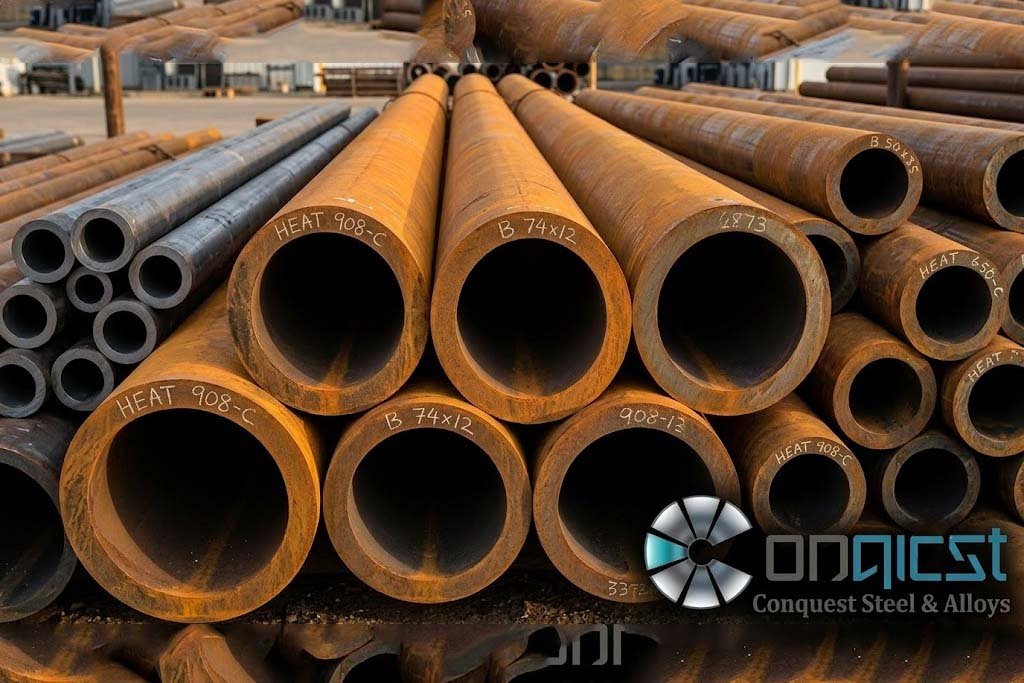
Corten Pipe & Corten Tube: Everything You Need to Know
- Mr. Amit Kumar
Corten Pipe: Grades, Properties, Applications and Buying Guide by Conquest Steel & Alloys
Corten pipe is a hollow steel product made from weathering steel, a low-alloy steel that forms a stable, rust-colored oxide layer (patina) when exposed to alternating wet and dry weather. That layer slows further corrosion, so the pipe usually needs no paint or coating for outdoor use in suitable environments.
The name comes from COR-TEN®, a trademark of U.S. Steel that stands for corrosion resistance and tensile strength. In practice, "corten steel pipe" is used as a generic term for pipes made to weathering steel specifications such as ASTM A588, ASTM A242 or EN 10025-5. Buyers also search for it as weathering steel pipe, COR-TEN pipe or rust-look steel pipe.
This guide explains how corten pipe works, which grades and standards apply, where it performs well, where it should not be used, and what to check before you order.
In this guide: How corten pipe works · Pipe vs. tube · Grades and standards · Properties · Applications · Corten vs. other materials · Limitations · Installation and welding tips · How to buy · FAQs
How Does Corten Pipe Work?
Ordinary carbon steel rusts continuously because its iron oxide layer is loose and flaky, so moisture and oxygen keep reaching fresh metal. Weathering steel behaves differently.
- Alloying elements: Small additions of copper, chromium, nickel and phosphorus change how the rust forms.
- Wet and dry cycles: Rain, dew and humidity followed by drying trigger the oxidation process.
- Dense patina: Over time the rust becomes a tight, adherent layer that limits oxygen and water reaching the steel beneath.
- Color change: The surface moves from bright orange to deeper brown, and eventually to a dark purple-brown, usually over about one to three years depending on climate.
The result is a self-protecting surface. This is why corten pipe is popular for outdoor structures where long service life and low maintenance matter.
Corten Pipe vs. Corten Tube: What Is the Difference?
The two terms overlap, but they are not identical. The main difference lies in how the product is sized, toleranced and used.
|
Feature |
Corten Pipe |
Corten Tube |
|---|---|---|
|
Primary purpose |
Conveying fluids, gases and slurries; also structural use |
Structural, mechanical and architectural use |
|
Sizing basis |
Nominal pipe size (NPS) and schedule or wall thickness |
Exact outside diameter and wall thickness |
|
Common shapes |
Round |
Round, square, rectangular, oval |
|
Tolerances |
Standard pipe tolerances |
Tighter dimensional tolerances |
|
Typical uses |
Pipe supports, piling sleeves, industrial lines (above ground), bollards, sculptures |
Façades, frames, railings, furniture, screens, planters |
Both share the same weathering behavior. If your project is about appearance and framing, you are most likely looking for corten tube. If the pipe will carry media or act as a round structural member, specify corten pipe and state the required standard and wall thickness.
Corten Steel Pipe Grades and Standards
Always specify corten pipe by standard and grade, not by brand name alone. The table below lists common weathering steel specifications. Confirm product form (pipe, tube or hollow section) and availability with your supplier.
|
Standard |
Grade examples |
Notes |
|---|---|---|
|
ASTM A588 |
Grade A, B |
High-strength low-alloy structural steel with improved atmospheric corrosion resistance; minimum yield strength commonly 50 ksi (345 MPa) in lighter sections |
|
ASTM A242 |
Type 1 |
Weathering structural steel, widely used for plates and shapes; fabricated into pipe and tube |
|
ASTM A847 |
Cold-formed welded and seamless tubing |
Covers round, square and rectangular structural tubing with improved atmospheric corrosion resistance |
|
EN 10025-5 |
S235J0W, S355J0W, S355J2W, S355K2W |
European structural weathering steels; S355 grades have a minimum yield strength of about 355 MPa in thinner sections |
|
EN 10219 / EN 10210 |
S355J0WP, S355J2WP |
Cold-formed and hot-finished hollow sections in weathering grades |
|
IS 11587 |
Weather-resistant structural steel grades |
Indian standard commonly referenced for Indian projects |
Mechanical and chemical limits change with grade and thickness. Always read the exact values on the standard and on your mill test certificate.
Typical chemical makeup
Weathering steels contain low carbon plus controlled amounts of copper (roughly 0.25–0.55%), chromium (roughly 0.4–0.8%), nickel and, in some grades, phosphorus. Exact ranges vary by specification, so use the standard as the authority.
Key Properties and Benefits of Corten Pipe
1. Atmospheric corrosion resistance - In suitable climates, weathering steel corrodes far more slowly than plain carbon steel once the patina stabilizes. Industry sources often cite several times better atmospheric corrosion resistance, but the actual rate depends on local humidity, pollution and salt exposure.
2. Low maintenance and lifecycle cost - Because the patina acts as the protection, you avoid repeated painting, blasting and recoating. For hard-to-reach or large installations, this can reduce lifecycle cost even when the upfront price per tonne is higher than for carbon steel.
3. High strength-to-weight ratio - Grades such as A588 and S355J2W offer higher strength than mild steel, which allows thinner walls and lighter structures for the same load.
4. Architectural appearance - The warm, earthy patina is a design feature in itself. It changes gradually and blends well with stone, timber, glass and planting.
Common Applications of Corten Pipe
- Bridges and civil structures: Pipe and tube members, railings, bearing details and pedestrian bridge elements where weathering steel is already accepted practice.
- Architecture and landscape design: Columns, façade supports, screens, garden structures, sculptures and public art.
- Industrial and infrastructure (above ground): Pipe racks, supports, conveyor structures, guard posts and covered process lines. For fluid service, confirm suitability with your design engineer and the applicable code.
- Urban furniture: Bollards, benches, tree guards and fencing in public spaces.
- Energy and utilities: Poles, masts and support structures where long outdoor life is needed.
Corten Pipe vs. Other Materials
|
Factor |
Corten (weathering steel) |
Painted carbon steel |
Galvanized steel |
Stainless steel |
|---|---|---|---|---|
|
Outdoor corrosion protection |
Self-forming patina |
Coating only; fails when damaged |
Zinc layer, sacrificial |
Very high, inherent |
|
Ongoing maintenance |
Low |
Repainting needed |
Low to moderate |
Very low |
|
Appearance |
Rust-brown, evolving |
Any color |
Metallic grey, dulls with time |
Metallic, consistent |
|
Strength (typical structural grade) |
High |
Moderate |
Moderate |
Varies by grade |
|
Relative upfront cost |
Moderate |
Low |
Moderate |
High |
|
Best for |
Atmospheric, architectural, bridges |
Controlled or short-life use |
General outdoor use |
Marine, chemical, hygienic use |
Choose corten pipe when you want a durable outdoor structure with a natural rust finish. Choose stainless or coated systems when the environment is continuously wet, salty or chemically aggressive.
Limitations: Where Not to Use Corten Pipe
Trust starts with honest limits. Corten steel is not a universal solution.
- Marine and coastal splash zones: Chloride (salt) prevents a stable patina from forming. Many bridge guidelines restrict weathering steel near the sea or where chloride exposure is high. Take the distance from the coast and local test data into account.
- Constant wetness or burial: Without dry cycles, the patina may not stabilize. Corten pipe is generally not recommended for buried service or permanent immersion without protection.
- De-icing salt exposure: Roadside use where salt spray is heavy can cause continuing corrosion.
- Rust run-off staining: Early rust-laden water can stain concrete, stone, paving and glass. Plan drainage, drip details and sacrificial surfaces.
- Trapped moisture: Crevices, flat ledges and unsealed joints hold water and cause uneven or accelerated corrosion.
- Early-stage handling: Fresh rust can transfer to skin and clothing until the patina settles.
When in doubt, ask a corrosion engineer to assess the site. Local climate data and exposure tests are more reliable than general rules.
Design, Installation and Welding Tips
- Design for drainage. Add drain holes, slope surfaces, avoid water traps and detail joints so water can escape.
- Allow wet-dry cycling. Open air with good ventilation helps the patina develop evenly. Avoid permanently covered, damp locations.
- Keep the pipe off the ground in storage. Store it on supports in the open air and avoid wet stacking with trapped water or contact with soil.
- Prepare the surface. Remove mill scale, oil and grease if you want even weathering. Light abrasive blasting can speed up uniform patina formation.
- Use matching welding consumables. Choose weathering-grade filler metal, for example a W-designated electrode such as E8018-W2 for shielded metal arc welding, so the weld matches the parent metal's color and corrosion behavior. Follow a qualified welding procedure specification (WPS).
- Protect adjacent materials. Use drip edges, gravel beds or sacrificial surfaces so run-off does not stain surrounding finishes.
- Seal where required. Where the pipe is partly embedded or in contact with concrete, apply a protective coating at the interface.
How to Buy Corten Pipe: A Practical Checklist
Before you request a quote, prepare the details below. Clear specifications reduce delays and mismatches.
- Standard and grade: For example, ASTM A588 Grade B or EN 10025-5 S355J2W.
- Product form: Seamless or welded; round pipe or hollow section.
- Dimensions: Outside diameter (or NPS), wall thickness or schedule, length and tolerances.
- Quantity and delivery schedule.
- Surface condition: Mill finish, pre-weathered, blasted or pre-patinated.
- Documentation: Mill test certificate (for example EN 10204 type 3.1), chemical and mechanical test results, and third-party inspection if required.
- Application and environment: Outdoor, coastal, industrial or buried, so the supplier can confirm suitability.
- Fabrication needs: Cutting, bending, welding, end finishing.
Supplier quality signals: traceable heat numbers, accredited mill sources, willingness to share test certificates, and technical support that can discuss environment-specific limits.
Frequently Asked Questions About Corten Pipe
What is corten pipe made of?
Corten pipe is made of weathering steel, a low-alloy steel with small additions of copper, chromium, nickel and sometimes phosphorus. These elements help form a protective oxide layer in outdoor exposure.
Does corten pipe rust?
Yes, it rusts on purpose. The difference from ordinary steel is that the rust forms a dense, adherent layer that slows further corrosion in suitable environments.
How long does corten pipe take to develop its patina?
Most installations develop a stable patina within about one to three years. The time depends on climate, wet-dry cycles, orientation and surface preparation.
How long does corten pipe last?
In favorable atmospheric conditions, weathering steel structures can last for decades with little maintenance. Service life depends on grade, wall thickness, drainage details and exposure, so it is not a fixed number.
Is corten pipe stronger than regular steel?
Many weathering grades, such as ASTM A588 and EN S355J2W, have higher yield strength than common mild steel grades such as S235. Compare the exact values in the specification for your thickness.
Can corten pipe be used near the sea?
Generally not without caution. Chlorides from sea spray can stop the patina from stabilizing. Use a coating system or a different material for coastal and splash zones.
Can corten pipe be welded?
Yes. Use matching weathering-grade consumables and a qualified welding procedure. Thicker sections may need preheat according to the standard.
Is corten pipe suitable for water supply or underground pipelines?
It is not usually recommended for buried or permanently wet service, because the patina needs dry cycles. For water or process lines, consult the project engineer and applicable codes first.
What is the difference between corten pipe and corten tube?
Pipe is sized by nominal size and schedule and is mainly for conveying media, while tube is sized by exact outside dimensions, comes in more shapes and is mainly used for structural and architectural work.
Is corten steel eco-friendly?
It avoids the need for paint or galvanizing to form its protective layer, and steel is highly recyclable. Its overall footprint still depends on production method, transport and project design.
Conclusion
Corten pipe combines strength, low maintenance and a distinctive weathered look. It works best in open-air environments with regular wet-dry cycles, good drainage and proper detailing. It is a poor fit for marine splash zones, buried service or constantly wet conditions.
If you are planning a project, define your grade, standard, dimensions and exposure first, then request test certificates from your supplier. Doing so gives you a pipe that performs as designed and ages the way you expect.
Need a quote or technical advice on corten pipe?


